
This story was co-published and supported by the nonprofit journalism organization Economic Hardship Reporting Project.
Joel Ruiz pointed his cane at a long piece of metal lying in the dirt. Unwelcome construction crews had left him on his riverfront property where he had lived and run a small fishing business for decades in San Ygnacio, Texas.
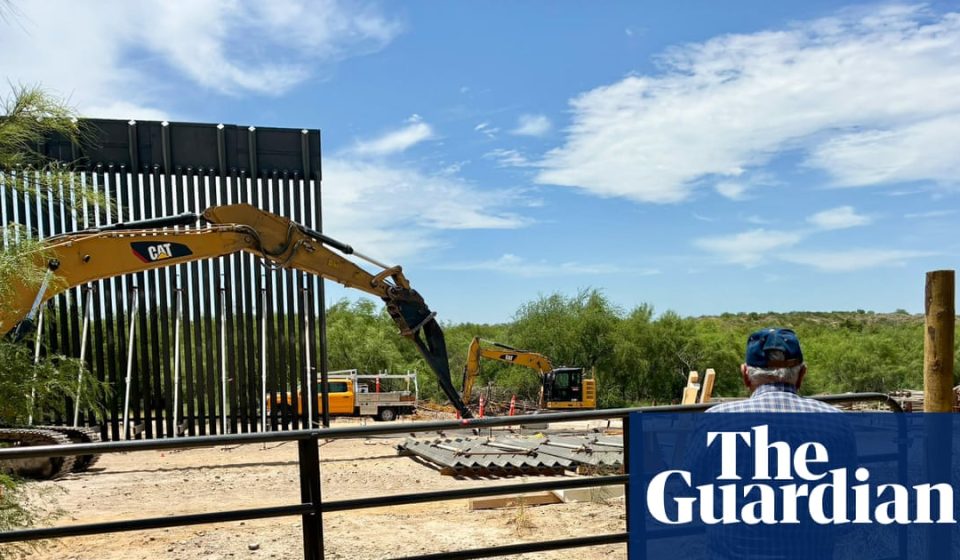
At 90, Ruiz still tends the land. But in July, heavy machinery excavated the land where mesquite and dense brush once grew. A steel barricade made of 30-foot-high bars was erected along the riverfront, including on his property directly across the Rio Grande from Mexico.
For months, Ruiz and a handful of other San Ygnacio residents have tried to stop construction of a federal border wall in their U.S.-Mexico town of about 400 residents. They’ve blocked bulldozers, been arrested, dug up 75-year-old land records and filed lawsuits challenging the federal government’s authority to build here. Even though residents say nearly all of the county’s waterfront land is privately owned, the government continues to build on it, asserting a decades-old right.
Although they have stopped construction on the disputed land for now — a verbal concession, not a court order — the reprieve is tenuous: The lawsuits are unresolved, federal money set aside for construction remains in place and residents know the crews could be back. But they rely on the memory of a city that has already risen up against the government.
“This little place is all we have,” said Elsa Hull, who owns property downriver with her two daughters. “But (residents) fought the federal government before and won — and we can do it again.”
“Life or death for us”
Founded along the Rio Grande in 1830, San Ygnacio grew from a group of ranches to a small frontier town. Today, its square is still lined with sandstone houses quarried from the banks of the river. The city is located in Zapata County, where about 38 percent of residents live below the poverty line and the median household income is about $39,000. Many work in health care, schools, restaurants and livestock. The Border Patrol is a major regional employer: its sector in Laredo employs approximately 3,025 people.
The construction is part of the Trump administration’s new push to build a border wall — a roughly $46.5 billion expansion funded by what’s known as the One Big Beautiful Bill Act. San Ygnacio is located in one of the areas where this money is currently arriving – and it is increasing as the number of apprehensions at the border decreases significantly. Ruiz said he rarely sees anyone crossing that stretch of river.
The Rio Grande is also San Ygnacio’s only source of drinking water, and the wall is being built in its floodplain. To speed construction, the Department of Homeland Security (DHS) waived 30 federal laws – including the Clean Water Act and the National Environmental Policy Act, eliminating the environmental review that would normally accompany a project of this scale. (DHS did not respond to the Guardian’s request for comment.)
To fill this gap, the Rio Grande International Study Center (RGISC), based in Laredo, commissioned its own. The assessment warned that the system of walls and buoys along and in the Rio Grande would make flooding worse — and, in places, fail outright.
“It’s a matter of life and death for us,” said Tricia Cortez, the center’s executive director. A breach in the wall system, she warned, would be sudden and catastrophic – homes destroyed, lives put in danger. “The wall will impede the river, forcing floodwaters to rise and move faster. »
Construction work in San Ygnacio had started without notice. Residents saw what they called a “man camp” rising on its edges and sensed something was coming. At a community meeting in June to discuss other business, word began to spread to the back of the room: contractors were clearing land along the river. Several residents rushed out and confronted the equipment operators, telling them they were on private property.
Hull spent 25 years as an environmental investigator for the Texas Commission on Environmental Quality. She remembers how she watched deer, bobcats, coyotes and river sunsets from a bench under a tree on the bluff. Construction work at the border has since cut down the tree and broken the bench.
“Every part of my life is closely tied to the Rio Grande,” Hull said. “For me, this river is sacred.”
When contractors arrived near Ruiz’s home and RV park in June, he invited Hull and her friend to look at the damage. Crews had razed trees and cut an irrigation line. Before leaving for a meeting, Ruiz signed a paper allowing Hull and her friend to stay and watch the property.
Two contractor trucks drove through the gate. Hull said a worker repeatedly showed a card marked “CBP” — presumably Customs and Border Protection. Then she noticed the Southwest Valley Constructors identification on his jacket.
“You’re not CBP,” Hull remembers him saying. When another truck approached, Hull drove his car to the entrance. More trucks arrived, followed by sheriff’s deputies, state troopers and Border Patrol agents.
“We were just surrounded by all these men,” Hull said.
Hull pulled out the county assessment map and argued the crews were on Ruiz’s property. One MP insisted the territory was federal. Finally, Hull put his water bottle on the hood of his car and sat down.
“Fuck,” she said. “Stop me.” They did it.
On August 14, Hull returned, carrying a flag reading “Keep Our River Free” on one side and “Walls and Buoys Kill” on the other. When a sheriff’s deputy called her from the other side of a fence, she thought he wanted to talk. Instead, she was handcuffed and arrested again.
A victory from the past
San Ygnacio had fought the federal government for these lands once before – and won. When government contractors insisted the land was federal, Frank “Chip” Briscoe, an architectural conservator, began digging through county records.
The trail dates back to the early 1950s when the government built Falcon Dam. Its reservoir submerged historic ranch communities and native sites along the river, and San Ygnacio also needed to be condemned and cleared for the reservoir. But the residents refused to accept it. In 1951, more than 200 people signed a petition organized by local veterans and civic leaders to oppose the measure. It worked: the government excluded San Ygnacio from condemnation, the only stretch along the river’s meander untouched by the reservoir. Seventy years later, the city invokes this same exclusion again.
Briscoe and attorney Ricardo de Anda searched subsequent property records and still found no evidence that the federal government subsequently acquired the excluded lands. The documents gave De Anda something concrete to act on. In mid-June, he met with the U.S. Army Corps of Engineers on Ruiz’s behalf, arguing that the crews had no legal basis to build on the disputed property.
When construction continued, De Anda sent a warning letter and filed two lawsuits against the federal government, alleging that it had taken possession of private property in violation of the Fifth Amendment. Two other landowners are preparing to file a lawsuit, and De Anda plans to sue the contractor, Southwest Valley Constructors, in state court. Property owners filed criminal complaints for trespassing, while a dozen residents urged local authorities to intervene.
About a month later, according to De Anda, the county attorney arranged a meeting with contractors and federal officials.
“They agreed to stop,” he said, and the crews withdrew – for now.
For De Anda, stopping construction is only part of the plan. “Our strategy is to influence national consciousness,” he said. The rest is just a matter of time. Every day they hold the line – with their bodies, their actions, their trials – buys more. They are looking toward the midterm elections, hoping that a change in Congress might give them another opening. They bet they can survive it.
During San Ygnacio’s Grito de Septiembre festival, enlarged copies of the 1951 petition and its signature pages were displayed in the square. Locals gathered around them, searching for the names of their ancestors.
Back on Ruiz land, people no longer come to fish for white bass and alligators; when the work began, it blocked access to its boat ramp. The small fishing business he ran here is now, in his words, “kaput”.
Yet Ruiz keeps coming to the river. In 1973, he helped establish a bird sanctuary next to his property. “My baby,” he called her. “I built it.”
Asked if his daily walks to the river had become a way of observing the return of crews – their equipment still unused on land – he shook his head.
He was there “just to be here,” he said.
Gn headline