
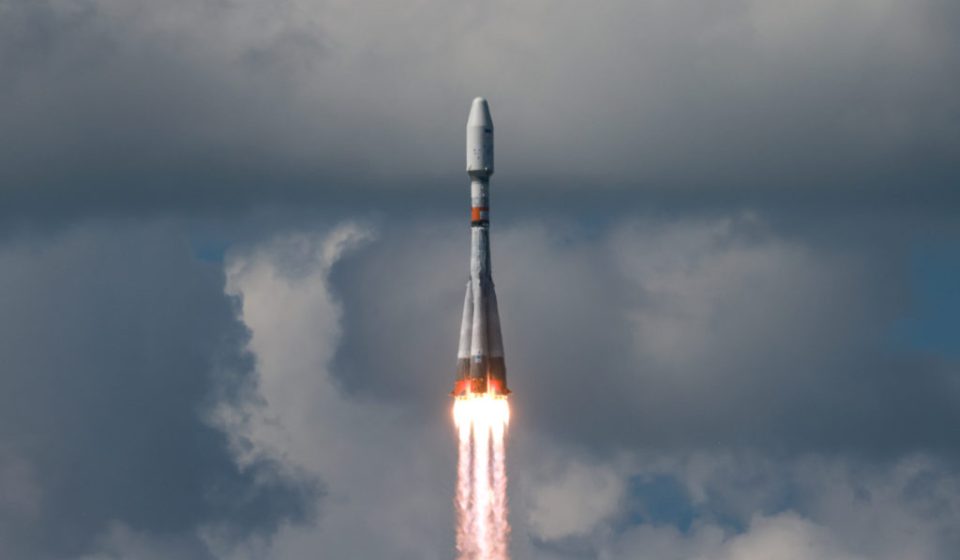

VIENNA (AP) — Air Force Secretary Troy Meink recently made headlines by confirming that the United States has deployed weapons in space. However, he did not specify what these weapons were, how they worked or whether they were aimed at other objects in space.
LEARN MORE: Analysis: What are the potential geopolitical implications of Russia’s alleged space weapon?
It’s not just America’s space weapons efforts that remain shrouded in mystery.
Here’s a look at the questions experts are concerned about:
What we know about weapons in space
Meink, speaking at a defense conference, said the United States had deployed “on-orbit space control weapons capable of defending the Joint Force against hostile adversarial action,” referring to U.S. forces. It is still unclear what type of weapon Meink was referring to.
Resources such as the 2026 Global Counterspace Capabilities Report, published by the nonprofit Secure World Foundation and based on publicly available information, help provide insight into potential space weapons.
The report lists five categories of counterspace capabilities. It examines systems developed by 13 countries, including the United States, Russia, China, India, Australia, France, Iran and Israel.
These include satellites designed to maneuver near, inspect, disable or destroy spacecraft. The report also examines ground-, air-, or sea-launched missile interceptors designed to kinetically destroy satellites.
Additionally, the report highlights electronic warfare, such as jamming, as well as high-power lasers or microwaves intended to blind or damage satellite sensors. The report also lists cyber operations targeting space networks.
Victoria Samson, chief director of space security and stability at the foundation, which advocates for the peaceful use of space, said the existence of various satellites and their physical locations in orbit are fairly transparent, but their capabilities and intended uses are more difficult to understand.
For example, the United Nations Office for Outer Space Affairs, based in Vienna, supports transparency in space by maintaining a registry that links each object to its responsible country. States that have signed a 1976 agreement are required to provide information on launches carried out by governments and private companies as well as the general function of the space object, but are not required to provide details of their purpose.
As an example of something that could be used for both military and non-military purposes, it was learned in 2021 that China had tested a satellite with a robotic arm capable of maneuvering towards a system, grabbing it, and moving it out of orbit. In 2022, China used such a system for the first time to tow one of its dead satellites out of orbit.
Additionally, the United States warned two years ago that Russia was developing a new space-based anti-satellite weapon, even though the White House said the danger was not imminent at the time.
John Kirby, then the White House national security spokesman, declined to say whether the weapon was nuclear-capable, but said it would violate the Outer Space Treaty.
Russia has denied developing such a new capability.
The Outer Space Treaty is a product of the Cold War
The Outer Space Treaty is the principal international agreement that establishes the rules and standards governing how countries explore and use space. In addition to Russia, the United States, China and all other nuclear-armed countries are parties to the treaty.
Article IV states that the parties “undertake not to place in orbit around the earth objects carrying nuclear weapons or any other type of weapons of mass destruction, not to install such weapons on celestial bodies, nor to station such weapons in space in any other manner.”
The treaty also declares that space is a global commons that can only be used for peaceful purposes.
LEARN MORE: Intelligence agencies suspect Russia of developing anti-satellite weapon to target Starlink service
The treaty was concluded in 1967, during the Cold War, as the United States and the Soviet Union both rushed into space exploration and conducted a series of nuclear tests in orbit.
At that time, the space was radically different.
Jonathan McDowell, a retired astronomer at the Harvard-Smithsonian Center for Astrophysics, has been tracking satellite launches for more than four decades.
By the end of 1967, according to McDowell, 128 satellites were in orbit and communicating with Earth. At the time, all satellites were the product of state-supported public projects. According to McDowell, there are about 16,810 functioning satellites today, many of which come from companies such as SpaceX’s Starlink network.
In 1962, the United States detonated a series of atomic bombs in space as part of Operation Fishbowl. The first, the Starfish Prime test, was launched from an atoll southwest of Hawaii. The explosion caused an artificial radiation belt that destroyed several satellites and partially destroyed street lights and telephone lines in Hawaii.
Similarly, the Soviet Union conducted nuclear tests in space as part of Project K between 1961 and 1962. The tests caused power grid outages, disabled telephone lines, and started a fire that destroyed an entire power plant in Kazakhstan.
The tests demonstrated the immense risk that atomic explosions in space pose to civilian infrastructure and communications on Earth, prompting superpowers to seek an agreement banning nuclear weapons and other weapons of mass destruction in space.
There is a flaw
Analysts say the treaty fails to address some of the challenges of modern times.
Jessica West, a senior researcher at Project Plowshares, a Canadian peace and security research institute, said the legal framework governing space needs to be “fundamentally changed.”
She said that while the Outer Space Treaty acts as a “constitutional foundation” that remains relevant and enforceable, the international community has not done the “hard work” to build a legal structure around the treaty, particularly when it comes to improving verification mechanisms for space activities and expanding principles to ban conventional weapons in space.
Michelle Hanlon, executive director of the Center for Air and Space Law at the University of Mississippi School of Law, agrees, saying there is a “gap” in the treaty when it comes to banning conventional weapons.
There is no consensus on what constitutes a weapon
International efforts to negotiate a new framework banning all weapons in space have stalled because there is no agreement on what constitutes a space weapon, among other things, according to Samson.
Many capabilities are “dual-use,” meaning they can be used for both civilian and military purposes, making it difficult to define what constitutes a weapon, she explained.
“You can approach a satellite to resupply it, but you can also approach a satellite to throw things at it, point a laser at it or try to jam it,” Samson said.
LEARN MORE: Space is the new battlefield with hijacked satellites and weapons in orbit
Talks of banning weapons come at a time when the United States, under President Donald Trump, is placing increasing emphasis on space.
In 2019, during his first term, Trump created the Space Force as a separate military branch. During his second term, he announced the “Golden Dome” anti-missile defense system, which includes deploying weapons in space.
Attempts by Russia and China to introduce a new treaty to prevent the placement of all weapons in space have hit a wall, in part because of the lack of definition. Additionally, Washington claims to ignore ground-based anti-satellite missiles which, when used, create enormous amounts of dangerous space debris.
In November 2021, Russia launched such a missile to destroy an old Soviet-era satellite, creating more than 1,500 pieces of debris that increased risks for American and Russian astronauts aboard the International Space Station and China’s Tiangong space station.
While progress on the comprehensive treaty appears to have stalled, international negotiations are now focused on discussing responsible behavior in space, such as avoiding the accumulation of space debris.
The American weapon could be non-kinetic
Samson said the United States has had a policy of avoiding the accumulation of space debris for many years, because such debris can interfere with the safety of spaceflight and harm its personal interests.
She also said that, for the same reason, it was possible that the space weapons Meink was referring to were non-kinetic weapons such as jammers.
Space debris is generated not only by kinetic space weapons, but also when satellites collide and break into countless fragments and smaller particles that travel at high speeds and are capable of destroying or damaging more spacecraft.
“If you start having collisions causing more debris, and more debris causing more collisions, you run the risk … of this irreversible cascading effect,” said Steven Freeland, emeritus professor of international law at Western Sydney University and professor at Bond University.
According to the European Space Agency, around 46,950 pieces of debris are regularly tracked by space surveillance networks in Earth’s orbit.
Based on statistical models, the agency estimates that there are millions of other small pieces of space debris circling Earth’s orbit.
Manzuk reported from New York. The Associated Press receives financial support from several private foundations. AP is solely responsible for all content. Find AP’s standards for working with philanthropic organizations, a list of supporters, and funded coverage areas at AP.org.
A free press is the cornerstone of a healthy democracy.
Support trusted journalism and civil dialogue.
Gn world