
Full-frame mirrorless models are divided into subcategories, all with a single number. The A1 series is, uh, alpha of the group with the highest price, aimed at professionals. It uses a fast “stacked” sensor that lets you shoot high-resolution 50-megapixel photos at high speeds of up to 30 fps, with incredibly precise autofocus. It also has advanced video capabilities with up to 8K shooting at 30fps, as well as Sony’s best electronic viewfinder (EVF). The latest model in the range is the A1 II, with the Roman numerals referring to the version number of the camera.
The A9 is also aimed at professionals, particularly sports shooters and journalists. These models have lower resolution (typically 24 MP), but stacked sensors designed for speed. The most recent version, the A9 III, comes with a “global” sensor that is the first ever in a mirrorless camera. It reads the entire image at once rather than line by line as traditional “rolling shutter” sensors do, eliminating distortion caused by fast-moving subjects. This is by far Sony’s fastest camera with RAW shooting speeds of 120fps.
Finally, the A7 designates Sony’s moderately priced mirrorless consumer range, divided into no less than four categories. The first A7 is the mainstream series that can handle both photos and videos, shoot at relatively high speeds, and is the least expensive. The early 2026 A7 V features a 33MP partially stacked sensor, 30fps burst speeds, and 4K full-frame video at 60fps.
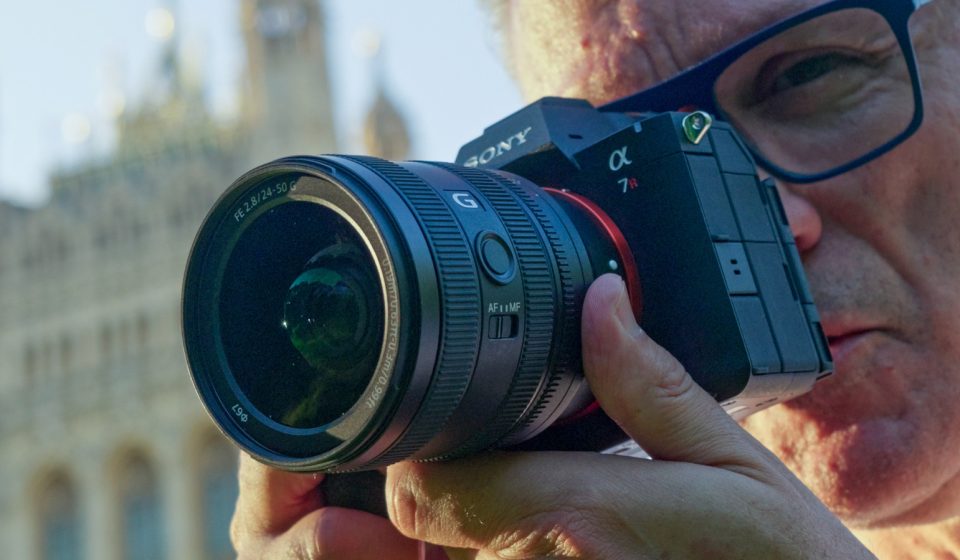
The more expensive A7R line (the “R” for resolution) has a high-resolution sensor ideal for detailed portraits or landscape photos. It can handle videos up to 8K, but creating videos is more of a side quest on this camera. The current camera is the A7R VI with a 67 MP stacked sensor that supports shooting speeds of 30fps and up to 8K video at 30fps.
Then there’s the A7S series designed for video. These feature low-resolution sensors with huge pixels designed to capture low light with minimal noise. The latest A7 III model was released in 2020, with a 12MP sensor and up to 4K 120fps capture. Sony now offers many dedicated video models in its FX line (I won’t go into detail here), which may be why it’s neglecting the A7S series.
Finally, there are the A7C models (the “C” stands for “compact”), including the A7C and A7CR. As the name suggests, these are compact and sleek versions of the Sony A7 and A7R models with exactly the same features. They have the viewfinder on the left side of the camera rather than in the middle and fewer manual controls to conserve space. The latest models are the A7C II (2023) with the same specifications as Sony’s A7 IV 33MP, and the A7CR which matches the A7R V.
Gn tech