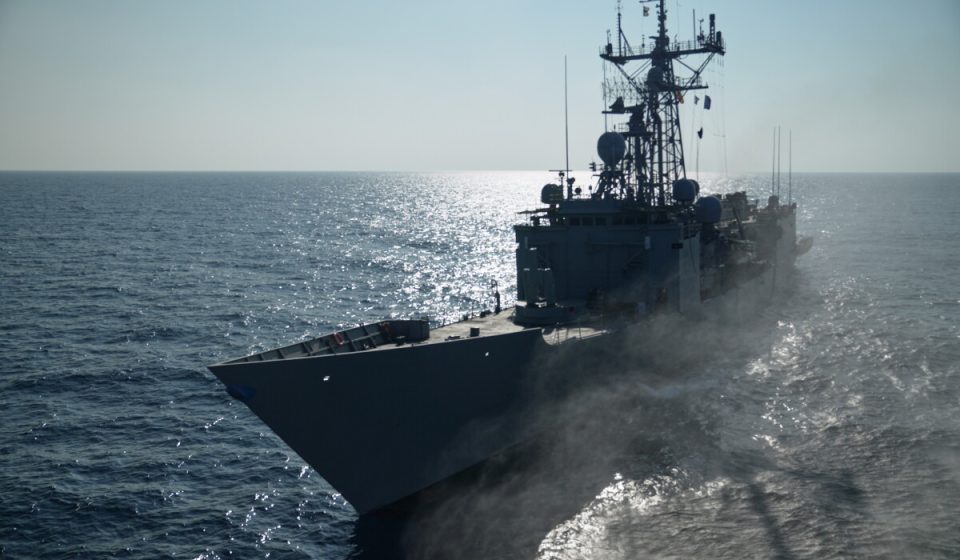
AT SEA IN THE GULF OF ADEN (AP) — In the azure waters of the Gulf of Aden, a container ship headed toward the Bab el-Mandeb Strait, a busy chokepoint increasingly threatened by conflict and pirates. Nearby, on a frigate, Spanish special forces were preparing their weapons.
” Fire ! » » ordered the master as four elite soldiers wearing sunglasses, masks and bulletproof vests took turns firing pistols and automatic weapons at targets showing vulnerable human organs.
It was just an exercise, but the threat of hacking is real. The frigate leads the European Union maritime security operation in the Gulf of Aden and the Somali Basin. These operators were honing their kinetic skills in case they were ordered to seize ships captured by pirates.
Piracy is on the rise between the Red Sea and the western Indian Ocean, as wars in Yemen, the Horn of Africa and Iran destabilize societies surrounding shipping lanes crucial to the global economy. Navy leaders describe an indirect link between fighting and piracy.
“Instability causes instability. Instability causes illegal activities. Illegal activities cause clans to go to sea,” Vice Admiral Ignacio Villanueva, commander of the EU’s Operation Atalanta, told the Associated Press.
Atalanta, a multi-tiered maritime anti-piracy force first established in 2008, patrols the western Indian Ocean and Gulf of Aden at the southern tip of the Arabian Peninsula. About 80 kilometers (50 miles) to the north is Bab el-Mandeba major artery of the global economy where, in peacetime, around 12% of global trade, including a quarter of all container traffic, passes between Asia and Europe.
Less than 30 kilometers wide, Bab el-Mandeb was fiercely contested by the Saudi-backed armed forces. government forces in Yemen and Houthi rebels supported by Iran. With traffic through the Strait of Hormuz severely disrupted, Bab el-Mandeb served as an alternative route for oil exports from the Persian Gulf, giving the waterway added importance.
A Spanish frigate patrols for pirates
The PA gained rare access to the Spanish frigate that leads the EU’s Atalanta mission in the region.
More than 200 crewmen are deployed on the ESPS Santa María, a 40-year-old, 4,000-ton warship bristling with large-caliber belt-fed guns, artillery, torpedoes and missiles. A helicopter and drone regularly take off from the rear cockpit to conduct aerial surveillance and scare away potential pirates.
Attacks on cargo ships off the east coast of Africa threaten the very way of life of Westerners, said Cmdr. Fernando María Zumalacárregui Alario, commander of the Santa María.
“If it’s in danger, if it’s threatened, you won’t have what you need. Prices will go up and our lives will be much worse,” he told the AP from the bridge.
Since the Houthis first attacked ships in Bab el-Mandeb in November 2023 because of Israel’s war in Gaza, there have been 79 pirate attacks in the region, including about 30 after the outbreak of the war in Iran in February, said Portuguese Commodore José Rodrigues Pedra, commander of the Atalanta Sea mission.
“I am not saying that there is a direct link with this crisis, but what I can say is that the crisis creates the crisis,” the commodore said from his cabin on the Santa María.
From a French military base in Djibouti, the Atalanta mission also operates a surveillance aircraft that conducts aerial patrols using radar, a sophisticated integrated camera system and navy photographers wielding long lenses.
The information collected is shared with partner military deployments from other European countries, the United States, South Korea, Japan, India and regional powers.
Atalanta is one of two EU naval forces present in the region. The other, Operation Aspides, focuses on the Red Sea and has more ships.
Hackers exploit regional unrest
After years of declining attacks, Somali piracy is on the rise again, driven by economic malaise,widespread malnutrition, political impasseAnd civil waranalysts say. Around 30% of the population The country faces critical levels of food insecurity, the UN said in February, amid sharp cuts in international aid.
Pirates based in Somalia’s semi-autonomous region of Puntland have seized tank trucksand a Turkish ship carrying weapons to the Somali government was captured. Off the Yemeni coast, hackers launched attacks before taking ships to Somalia, a new tactic exploiting the chaos in the south of the Arabian Peninsula.
The AP followed this resurgence of piracywith six commercial vessels hijacked between April and August this year.
Five were subsequently released, but the MT Asana, a Tanzanian-flagged tanker captured in July, remained under pirate control in Somali territorial waters since the October 16 Operation Atalanta update. The International Maritime Organization said earlier that month that 22 sailors remained captive on board.
Even when the ships are recaptured, the hostages are in danger. Five crew members died during the September recovery operation of the Honor 25 tanker, held since April. The IMO said 44 sailors were freed from that ship and two other tankers, Eureka and Sibu 1, also known as Seamull.
Many attacks have targeted fishing boats, which can be used as floating bases for raids on larger ships. Indian forces freed an Iranian fishing boat in early November after an operation lasting more than 48 hours, the Indian Defense Ministry announced.
Piracy in the region first peaked 15 years ago, when Somali attackers took hostages and demanded millions of dollars in ransom. Anti-piracy efforts largely worked until 2023, but “the conditions have always been ripe for piracy to resurface,” said Jakob Larsen, head of safety and security at giant shipowners’ association BIMCO.
One factor could be skyrocketing fuel prices due to the war in Iran, forcing people to seek new livelihoods. “Hacking is one of those ways,” Larsen said.
While Iran and the Houthis have control over the Strait of Hormuz and Bab el-Mandeb, piracy offers benefits to both, said Christopher Hockey, a researcher at the Royal United Services Institute.
“It suits the Houthis, it suits the Iranians to further disrupt maritime traffic through piracy,” Hockey said. He warned that regional shipping lanes could soon be divided between cargo ships with expensive guards and those without them and running the risk of capture at sea.
“No ship has ever been hijacked with an armed security team on board,” Hockey said. “Those ships that are saving money – or doing something questionable – are the ones that are going to continue to be targeted.”
Hockey and other analysts who spoke to the AP say the EU mission helps thwart piracy, but its success is difficult to measure: Commanders say would-be pirates typically retreat as soon as they see a drone, plane, helicopter or ship.
Shipping companies are already diverting ships, beefing up security and operating with higher costs like insurance, said Mahmoud Shehrah, a former Yemeni diplomat and fellow at the Chatham House think tank. Regardless of piracy, he said the Houthis have “significantly expanded their logistical influence across the Horn of Africa.”
The Houthis have contacted some companies to offer protection services, said Mohammed al-Basha, founder of risk consulting firm Basha Report.
“They say, ‘OK, the Suez Canal brings in six billion a year and, you know, we have a natural canal, from Allah, the strait. This is Bab el-Mandeb. And so how can we make money from this?”
___ Associated Press writer Omar Farouk in Mogadishu, Somalia, contributed to this report.
Gn world