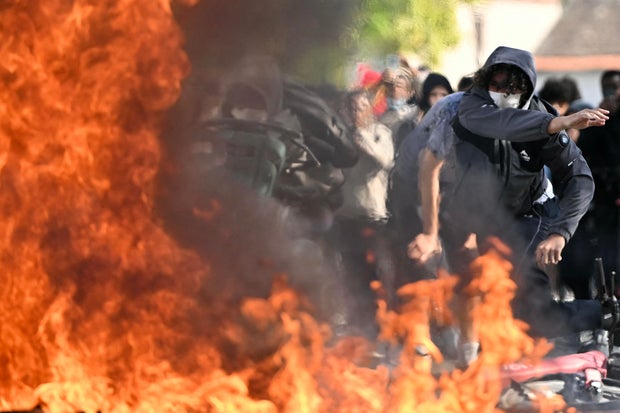
Student protests in France have spread from Paris, with violent clashes forcing hundreds of high schools to close

Paris — French high school students set fires outside schools and clashed with police Friday as a protest movement that forced closures or disrupted teaching at more than 560 establishments showed no signs of abating.
The movement, which began last week in the Paris region and quickly spread across the country, saw teenagers in their final year blocking access to buildings and clashing with police.
Students say their class hours are excessively long, conditions are inadequate, including overheated classrooms and dilapidated buildings, and there are too many staff absences.
LOU BENOIST/AFP/Getty 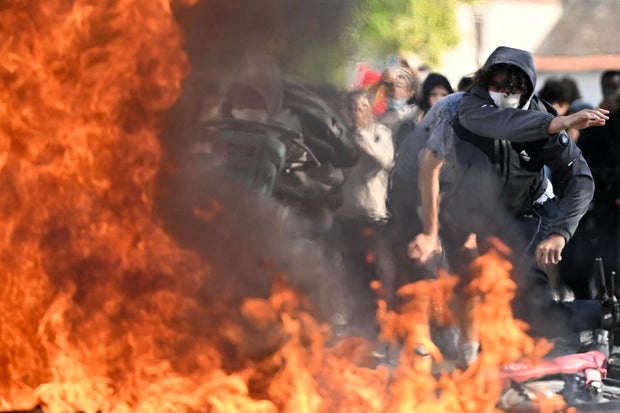
“For a year we didn’t have a science teacher. We don’t have textbooks,” said Simon, a 15-year-old who refused to give his name outside the Turgot high school in central Paris. “And yet, we’re the lucky ones. It’s even worse in the suburbs.”
The government says the grievances are legitimate but has condemned what it calls “urban violence.”
Students accused police of using excessive force and causing injuries by regularly firing tear gas to disperse protests.
In Paris, on Friday, a fire damaged the entrances to two high schools, firefighters being called to put out the flames, noted an AFP photographer.
“Held hostage by ultra-violent fringe groups”
The Minister of Education, Edouard Geffray, declared that “the high school movement is being taken hostage by ultra-violent marginal groups.”
His ministry indicated on Friday that teaching had been disrupted in more than 560 high schools out of the 3,700 in the country. More than 1,000 high schools were affected on Thursday, the Interior Ministry said.
Many high schools have planned to provide lessons remotely, particularly in the southern city of Marseille.
At least 65 staff members have been injured, including 40 high school principals, since the movement began, Geffray said on BFMTV, while around 170 students have been injured and more than 100 high schools have suffered “serious damage.”
Romain Costaseca/Hans Lucas/AFP/Getty 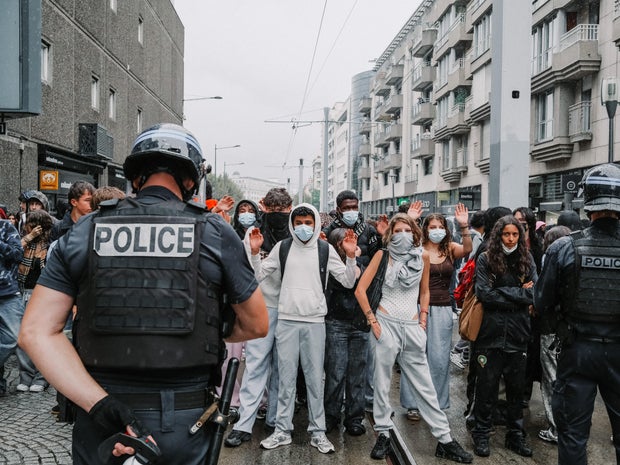
“Parents clearly need to step up and tell their children not to participate” in the protests, he said. “What matters now is to ensure that our children are no longer on the streets, because they are in danger.”
Justice Minister Gérald Darmanin said he had asked prosecutors to hold parents responsible for damage caused by their children during the protests and to “pay for reparations.”
Since the start of the movement, around 2,000 people have been taken into custody “90% of whom were minors”, Darmanin told RTL.
“We won, our school is closed”
In Rennes, in the west of the country, tension was already palpable in front of the Jean-Macé high school with students dressed in black and hooded standing not far from a strong police presence.
“As far as we are concerned, we have won: our school is closed this morning,” said Lola, 16, who declined to give her last name.
She condemned what she considers to be police violence.
“This makes us even more angry: the police do not have the right to beat us or use tear gas against us,” she said.
Mohamad Salaheldin Abdelghani Alsayed/Anadolu/Getty 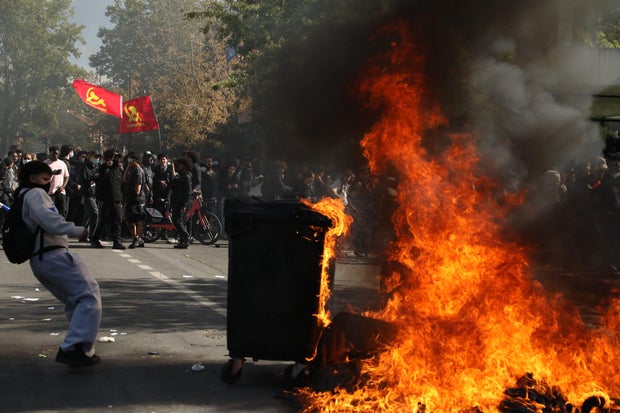
Police used tear gas at Kerichen high school in Brest, western France, an AFP photographer noted.
The protests also had a strong political echo just over six months before the presidential elections, with the government accusing the extreme left France Insoumise (LFI) – whose incendiary leader Jean-Luc Mélenchon is running for president again – of being at the origin of the movement.
But a senior LFI official, Manuel Bompard, accused the government of “sinking into conspiracy theories”.
Gn headline