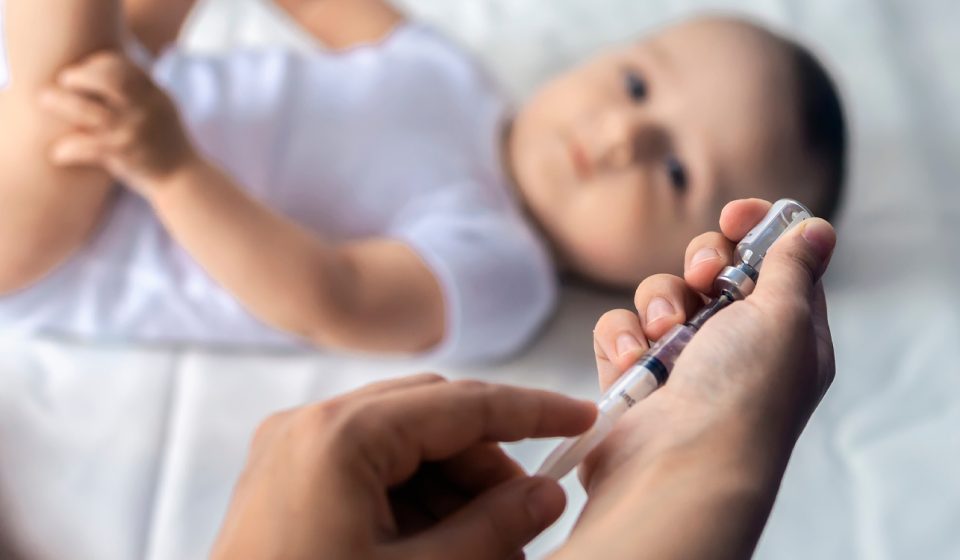

A new study of more than 2.5 million children shows that receiving the measles, mumps and rubella vaccine before the age of two is not associated with an increased risk of developing autism. The results, published in The Journal of Pediatric Infectious Diseasesindicate that the specific timing of vaccination was not related to the likelihood of a child being diagnosed with a developmental disorder.
Autism spectrum disorder is a developmental condition that affects the way a person communicates, interacts with others, and experiences the world. This disease is currently estimated to affect approximately 3.2 percent of children in the United States. The measles, mumps and rubella vaccine is a standard early childhood vaccine that protects against three highly contagious and potentially serious viral infections.
Fears linking this routine vaccine to autism persist among some parents, often leading to delayed or refused vaccinations. Much of the concern stems from a case series dating back to 1998, a report involving just 12 children that was later withdrawn due to scientific misconduct. Over the years, numerous large-scale studies have found no link between the vaccine and developmental disorders.
Even with this large body of research, observational studies of vaccine safety face inherent design challenges. Factors such as a family’s health habits, early parental concerns about a child’s development, and a child’s age can influence both when they will be vaccinated and whether they will be diagnosed with autism.
If an analysis does not take into account that children receive vaccines at different stages of development, the results could be skewed. The research, led by Todd L. Burstain of UW Medicine, aimed to resolve these complexities by using a more precise study design.
The authors used an approach known as age-anchored benchmark analysis. This method groups children according to the age group in which a vaccination decision is typically made, comparing vaccinated and unvaccinated children within these defined age groups to reduce bias.
To carry out the research, scientists analyzed records from Cosmos, a massive electronic database of health records spanning hospitals and clinics across the United States. The dataset included 2,560,035 children who had at least one routine primary care visit between 12 and 24 months of age. The prevalence of childhood autism in this sample was 2.55 percent. The researchers focused on a specific diagnostic code for childhood autism, a narrower category than the entire autism spectrum, which partly explains why the prevalence in the sample was lower than the national estimate.
The researchers excluded all children diagnosed with autism at or before 11 months of age to ensure the vaccine was administered before diagnosis. The children were followed until age eight or until December 2024. By age 24 months, 91.4 percent of children in the sample had received their first dose of the measles, mumps and rubella vaccine.
The authors divided the children into defined age groups, such as 11.5 to 12.5 months, 12.5 to 13.5 months, and up to 24 months. Within each window, they compared children who received their first dose during that window with children who were not vaccinated at the start of the window and who were not vaccinated throughout follow-up.
To ensure the comparison was as fair as possible, the researchers adjusted for factors that might influence both vaccination and autism diagnosis. These included maternal age, race and ethnicity, gestational age at birth, whether the baby was small for gestational age or from a multiple birth, diabetes or genital or urinary tract infections during pregnancy, neighborhood disadvantage, and region of the country. They avoided taking into account factors occurring after vaccination, which can skew the results.
In all age groups analyzed, the first dose of the vaccine was not associated with an increased risk of autism. In the primary analysis, covering vaccination between 11.5 and 24 months, the adjusted hazard ratio was 0.97, with a 99 percent confidence interval of 0.91 to 1.03. A risk ratio compares how quickly new diagnoses occur in two groups, and because this range includes 1.0, the result does not correspond to any difference in risk. The estimate of 0.97 translates to a 3% lower diagnosis rate among vaccinated children, a difference that is statistically indistinguishable from zero.
In two of the later periods, 14.5 to 17.5 months and 17.5 to 24 months, vaccinated children had slightly lower rates of autism diagnosis, with hazard ratios of 0.90 and 0.92. The authors attribute small discrepancies like these to residual biases in the data rather than any protective effect of the vaccine.
The results held up to different analyses. The results remained essentially unchanged with more birth factors added (risk ratio 0.97) and without the neighborhood measure, which was missing for 53 percent of children (risk ratio 0.96). They were also retained after excluding children with only one recorded autism diagnosis.
To double-check their methodology, the researchers also tested a negative control exposure. They looked at the pneumococcal conjugate vaccine booster, which is given for about 12 to 15 months to prevent bacterial infections but has no theoretical link to autism. A negative control is a comparison where no effect is expected, used to check whether a method produces false signals. The similar result for the pneumococcal booster suggests that the analysis did not generate spurious links related to routine examinations, supporting the authors’ view that residual biases are unlikely to explain the measles, mumps, and rubella results.
As with any research, there are a few things to keep in mind. The study relied on observational medical records, meaning the researchers couldn’t control every variable in a child’s life.
Notably, the dataset did not include information on family history of autism. If parents who already have an older child with autism are more hesitant to vaccinate their younger children, this missing detail could skew the data. Such a tendency would tend to make the vaccine appear protective rather than harmful. A 2015 study cited by the authors, which examined American children whose older siblings had autism, also found no link between the measles, mumps, and rubella vaccine and autism.
Additionally, children who received the vaccine tend to benefit from much longer follow-up periods in the medical system than unvaccinated children, with a median of 853 days for vaccinated children compared to 366 for unvaccinated children. Typically, spending more time interacting with health care providers creates more opportunities to receive a formal diagnosis, but researchers have still found no link between the vaccine and autism.
The requirement that children have linked biological parent records also excluded a substantial proportion of otherwise eligible children from the analysis. This means that the results may not reflect the experiences of all children receiving medical care.
Future studies could incorporate external data on family history and socioeconomic factors to provide an even more accurate picture. Scientists could also test whether these findings apply to broader autism spectrum disorder diagnoses rather than the specific childhood autism diagnostic code used in this analysis.
The study, “Association between first MMR vaccination before age 2 and childhood autism in a US EHR cohort of 2.5 million children,” was authored by Todd L. Burstain, Dale Jacques and Jennifer M. Burstain.
Gn Health