Supreme Court liberals raise jurisdictional questions in Suncor v. Boulder case

NEWYou can now listen to Fox News articles!
Repeated questions from Justices Ketanji Brown Jackson and Sonia Sotomayor about whether the Supreme Court has jurisdiction to hear a high-profile climate case that could expose oil companies to lawsuits across the country have led conservative lawyers to believe that liberal justices are seeking a “way out.”
“The fact that they keep trying to create a jurisdictional issue tells me that they’re not sure they have the votes in this space,” Carrie Severino, president of the JCN, a conservative legal group, told Fox News Digital. “Jackson and Sotomayor were looking for an escape route.”
The Supreme Court began its new term Monday, hearing its first arguments in Suncor v. Boulder, in which she will rule on whether the state’s tort laws can be used to seek damages from oil companies for climate change, even when the alleged damages occur outside the state or mainland. The justices will also decide whether the Supreme Court has jurisdiction to hear this case now, since the case is still before the Colorado Supreme Court.
The case before the high court is in an unusual procedural situation, meaning the justices could resolve it without ever reaching the blockbuster state-federal fight at its center. This dispute centers on whether Colorado can use its own laws to seek damages for alleged harm caused by other states’ emissions or whether it is a matter to be regulated by the federal government and Congress.

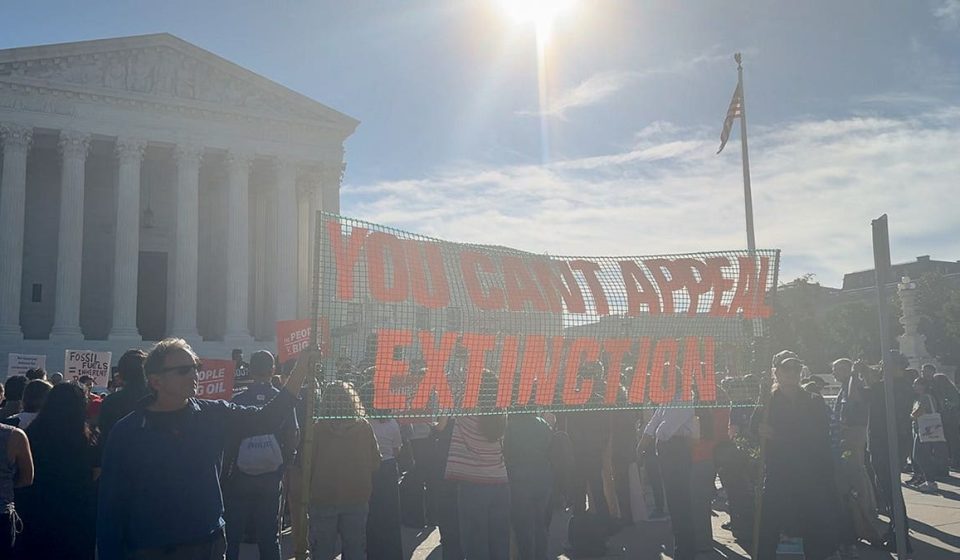
Climate activist protesters gather outside the Supreme Court ahead of oral arguments for Suncor v. Boulder, October 5, 2025. (Elaine Mallon/Fox News Digital)
SUPREME COURT STARTS NEW TERM WITH HIGH-PROFILE LOOK AT CLEAN AIR AND FEDERAL AUTHORITY
“The questions posed by Jackson and Sotomayor trying to say that it would be premature for the court to issue an opinion are simply the work of liberal justices trying to find a way out of the case because they fear being outvoted on the main question: Does a federal law like the Clean Air Act preempt all state claims like those asserted here,” Hans von Spakovsky, senior fellow at Advancing American Freedom, told Fox News Digital.
Questioning Suncor lawyer Kannon Shanmugam, Jackson suggested the dispute may have been brought to the Supreme Court too soon, calling it “premature from the perspective of this court exercising jurisdiction.”
She also repeatedly questioned why the court could not wait to hear the case, saying the court did not “have all of the facts” and that the court did not “really know enough to be sure” that the theories put forward were applicable.
“I feel like the defendants…are bringing the matter back to federal court before the state courts have really had a chance to determine who the source is and what their allegation is as to how that causation occurs,” Jackson told Senior Deputy Solicitor General Sarah Harris, who argued on Suncor’s behalf.
Meanwhile, Sotomayor refused to drop her jurisdictional questions with Shanmugam, proposing that the Supreme Court send the case back to the Colorado Supreme Court.
“If we’re not sure of your qualification, because there are certainly a number of amici briefs who disagree with that characterization, shouldn’t we certify this issue to the Colorado court instead of deciding it? We need to be sure of our competence before we accept it,” Sotomayor said.
Alabama’s Republican Attorney General Steve Marshall told Fox News Digital it was clear liberal judges were trying to sow doubt about their competence.

Climate activists gather outside Supreme Court for oral arguments in Suncor v. Boulder, October 5, 2026. (Elaine Mallon/Fox News Digital)
THE SUPREME COURT CAN RESTORE HEALTH AND STOP THE LEFT’S RADICAL CLIMATE AGENDA
“Well, I think you saw Judge Jackson and Judge Sotomayor trying to find a way out of this court, basically saying that the court does not have jurisdiction at this point in the case to be able to make a final decision. I think you saw the lawyers on behalf of Suncor being able to draw the distinction.”
If the Supreme Court declines to address the issue of federalism, the Colorado Supreme Court’s decision allowing Boulder’s claims to proceed under state law would remain in effect, leaving unanswered the broader question of the extent to which states can use tort law to pursue climate claims against energy companies.
Chief Justice John Roberts asked Boulder attorney Kevin Russell whether a Boulder victory could trigger similar lawsuits nationwide. Russell said there are legal limits, but acknowledged to Justice Clarence Thomas that Boulder’s theory could make it possible to sue other fossil fuel companies.
“The chief justice and the court do not like to make decisions without limiting principles, decisions that could open the door to unlimited litigation and claims. Kannon Shanmugam, Suncor’s lawyer, emphasized this again at the very end of the oral argument when he pointed out that “not only are there 90,000 political jurisdictions that could sue, but individuals could also sue seeking damages due to global warming,” von Spakovsky said.
“And he also highlighted a point that the conservative majority disapproves of: that Boulder is trying to resolve a major policy issue in the courts rather than in the legislature,” von Spakovsky continued.

Conservative lawyers say Justices Ketanji Brown Jackson and Sonia Sotomayor are looking for an “exit.” (Getty Images)
SUPREME COURT LAUNCHES NEW MANDATE WITH NEW QUESTIONS ABOUT ITS LEGITIMACY AND FUTURE
Suncor supporters say the lawsuits could “bankrupt oil companies” and lead to higher prices for consumers.
“It’s basically creating a carbon tax on producers and emitters across the country, which would include, by the way, my ranchers in Alabama producing beef for our country, those who are creating concrete to be able to build structures and grow our economy,” Marshall told Fox News. “They ultimately want to bankrupt this industry so their preferred climate change policies come into play.”
“They’re literally going after behavior that’s happening all over the world,” Utah Attorney General Derek Brown told Fox News Digital. “They want to regulate not only what happens in Colorado, but also what happens in my state of Utah or in Saudi Arabia. That’s not how the system works. So really, this case comes down to one main question: who decides things like energy policy. And ultimately, in our system, it should be Congress.”
Meanwhile, Boulder claimed that ExxonMobil and Suncor knew about the climate risks associated with fossil fuels for decades, but misled the public about those risks. Communities estimate that taxpayers could face costs of more than $100 million to adapt to climate-related impacts, including wildfires, drought and damage to roads and other infrastructure.
Former Washington Gov. Jay Inslee, a Democrat and longtime advocate for aggressive action on climate change, argued that these costs were already being felt by communities across the country.
“As governor, I have worked with many families who have lost their homes,” Inslee told Fox News Digital. “So many communities have been virtually burned to the ground, and they should be able to spend a day in court to hear the evidence, to determine whether the oil and gas industry’s lies are legitimate, to make sure they are held accountable.”
The complaint referenced an internal ExxonMobil memo from 1977 that was circulating among the company’s top executives. The memo states that “current scientific opinion is overwhelmingly in favor” of the contribution of fossil fuels to increased CO2 emissions.
CLICK HERE TO DOWNLOAD THE FOX NEWS APP
“Their own scientists knew that their product was dangerous, that it was going to cause more fires. And they knew that for decades, in 1967, their own scientists were telling them that it could be catastrophic, so they knew that, they lied about it,” Inslee said. “Now Americans have the right to be in court. No one should prohibit an American from appearing in court.”
Gn headline