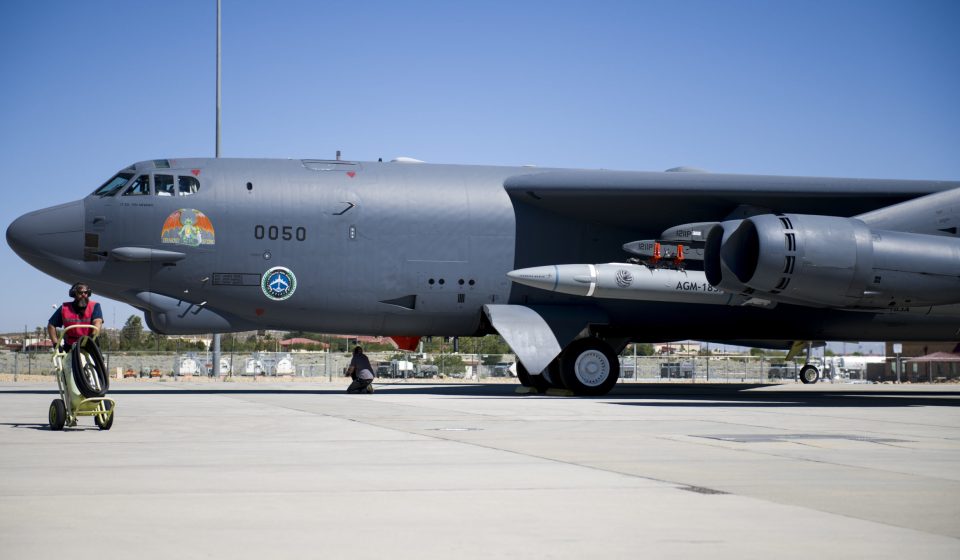

The Air Force has awarded Lockheed Martin a $694 million contract to produce its first-ever hypersonic missile, the Air-Launched Rapid Response Weapon, the service announced Oct. 26.
The move moves ARRW from testing to production, a major step for a much-sought-after capability. The Air Force, citing operational security concerns, has not released details on how many planes are ordered or when they are to be delivered.
Budget documents describe ARRW as a ranged weapon and “a lethal capability against high-value, time-sensitive attacks.”
targets. » It is too large to equip most combat aircraft and will initially be deployed on the B-52 and is also believed to have been tested on the B-1. A multi-stage boost-glide weapon, it uses a rocket booster to accelerate to hypersonic speed, when the booster separates and falls away, leaving a hovering vehicle that can maneuver toward its target at five times the speed of sound. or more: at least 3,800 miles per hour or a little more than one mile per second.
“This is a turning point in our advanced weapons roadmap,” Air Force Secretary Troy Meink said in a statement. “By moving the ARRW from testing to production, we are providing our combatant commanders with a credible, high-velocity strike weapon capable of penetrating the most advanced anti-access and area-denial systems.”
Development of the ARRW began in 2018 when the Air Force signed a design contract with Lockheed worth up to $480 million. The program builds on the joint DARPA-Air Force X-51 and aims to deliver a prototype by 2021.
The Air Force conducted captive-carry tests in 2019 and that same year awarded Lockheed a $988.8 million contract modification for a critical design review. The first operational flight test was planned by the end of 2020, with initial operational capability planned for 2022.
But the first launch test, postponed until April 2021, failed and two other failures followed. The first successful test took place in May 2022, at which point funding became an issue. In 2021, Congress removed funds for 12 ARRW missiles from the fiscal 2022 budget plan, and the Air Force zeroed out funds for 2023.
In March 2023, Air Force civil acquisition manager Andrew Hunter said the program would end without purchases. Air Force leaders said they would instead focus on the smaller hypersonic attack cruise missile and other reusable hypersonic systems.
In 2025, however, Gen. David Allvin, then Air Force chief of staff, told Congress that the Air Force would purchase ARRW, and the fiscal 2026 budget included $362 million for that purpose. The contract was awarded on September 29, 2026, but the decision was not announced until a month later.
The Air Force’s 2027 budget request included $452 million for ARRW production. This budget is currently stuck in Congress and the Pentagon is operating under a continuing resolution based on 2026 funding levels. The Future Years Defense Plan projects that purchases from 2028 to 2031 will range from $556 million to $621 million per year. The quantities are referred to as “unclassified controlled information” and are not made public.
“Fielding the ARRW enhances our ability to maintain targets at risk anywhere in the world,” Air Force Chief of Staff Gen. Kenneth Wilsbach said in a statement. “This hypersonic weapon provides the Joint Force with a flexible and rapid response option in highly contested environments.”
Gn usa