The Federal Reserve held interest rates steady Wednesday, despite no recent progress in bringing inflation back to the central bank’s 2 percent target.
Officials voted 10-2 to keep rates between 3.75 and 4 percent. This range was reached in September after policymakers unanimously decided to raise rates for the first time since 2023.
Lisa D. Cook, a Fed governor whom President Trump tried to fire, on Wednesday expressed her first-ever dissent on the Fed’s monetary policy settings in favor of a quarter-point increase. She was joined by Beth M. Hammack, president of the Federal Reserve Bank of Cleveland, who has expressed her disagreement several times this year.
In a statement accompanying the rate decision, the Fed said it still had work to do to suppress inflation, which it described as “high.”
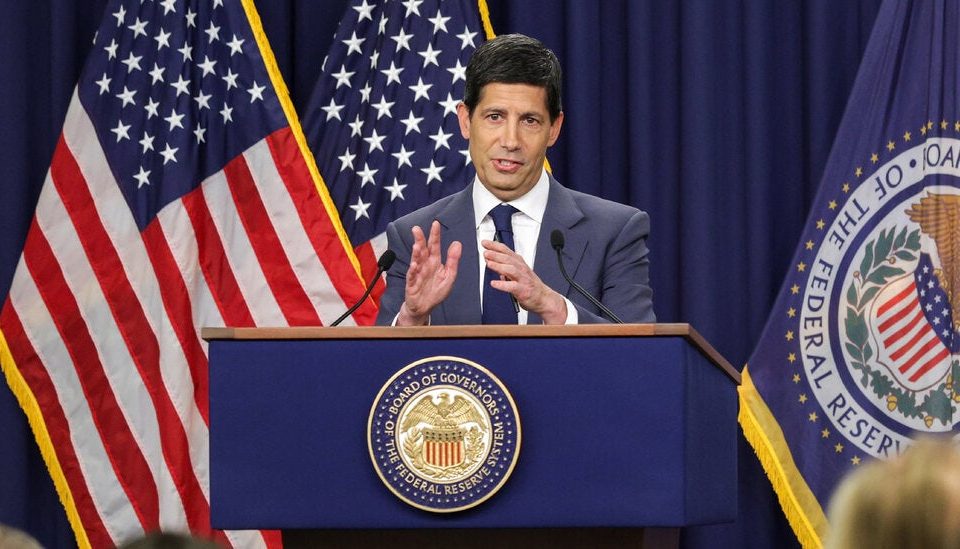
At a news conference after the decision, Kevin M. Warsh, the Fed chairman, began with an optimistic assessment of the economy but stressed that inflation was still too high.
He also said the central bank would reduce the number of meetings in which it votes on interest rates. Mr. Warsh said the Fed would meet eight more times in 2027, but one of those meetings would focus “exclusively on overall monetary policy strategy” and would not include a vote on interest rates. Starting in 2028, the Fed plans to devote two meetings to this broader strategy.
The Fed met days before midterm elections that will decide whether Republicans retain control of Congress and how much leeway President Trump will have to implement his agenda in the second half of his term. Affordability issues are top of mind for voters after nearly six years in which inflation exceeded the Fed’s target.
“Politics played no role in this decision,” Warsh said when asked about the midterm elections.
Mr. Warsh, who took over as Fed chairman in May, has made controlling inflation the top priority of his four-year term.
Since the Fed officials’ meeting in September, inflation data has been far from reassuring. Price pressures appear to be widening after shocks from Mr. Trump’s tariffs and the U.S.-Israeli war on Iran. Energy prices have skyrocketed, threatening to spill over into other goods and services.
The economy has continued to grow at a brisk pace despite these headwinds, fueled by an investment boom driven by companies scrambling to develop their artificial intelligence capabilities. However, wage gains have failed to keep up with rising prices, meaning Americans earn less for an hour of work.
The U.S. government’s borrowing costs have risen sharply, making not only mortgages and other consumer loans but also business financing more expensive. Some AI companies, which have issued significant debt to finance their expansion plans, appear particularly exposed.
As a result, financial conditions, which track credit availability across the economy, appear slightly less accommodative. The extent to which this helps the Fed control inflation will largely depend on whether these conditions continue to tighten.
Ms. Hammack’s dissent on Wednesday was widely expected given her view that the Fed’s policy settings are not holding back the economy. Ms. Cook’s dissent is notable as she is engaged in a legal battle with Mr. Trump, who has sought to pressure the Fed into lowering rates. Ms Cook became a target in the summer of 2025 when the president seized on unproven allegations that she committed mortgage fraud before joining the central bank.
Mr. Trump renewed that effort after the Supreme Court ruled against him on the issue earlier this year. The White House launched its own investigation into Ms. Cook and summoned her for an in-person hearing.
Gn headline