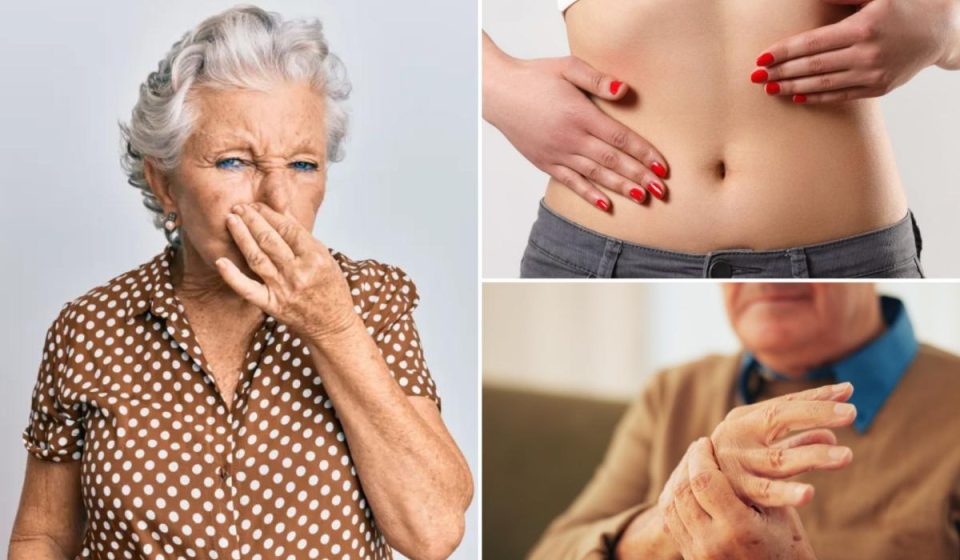

Your funky belly button could hold vital clues about your health, including signs of Parkinson’s disease, which is notoriously difficult to diagnose.
No laboratory or test can confirm a diagnosis of Parkinson’s disease, and doctors must rely on symptoms, medical history, and tests like MRI to rule out other conditions. Sometimes it can take years to get answers.
In fact, people are sending their T-shirts to a Scottish woman named Joy Milne, who claims to be able to detect the disease long before symptoms appear.
She first smelled it on her husband about ten years before he was diagnosed with Parkinson’s disease. Milne was even put to the test at the University of Edinburgh – and discovered who had the disease with “incredible” accuracy.
New research reveals how Parkinson’s disease can leave a detectable chemical signature in body odor, opening the door to earlier, more accessible diagnoses – without shipping to Scotland.
What research has shown
All day, every day, your body produces oil, sweat and dead skin. Everything from what you eat to the medications you take is processed by the body and comes out in these secretions, in addition to your breath, urine, and saliva.
Most of these elements are removed through daily cleaning. What the researchers deliberately tested here were places that escape regular cleaning: the belly button, the inside of the nose, and the bowl-shaped area outside the ear canal.
So even with exceptional cleaning, odors usually accumulate in these areas. They are “less exposed to perfume, soap and other factors,” they explain, making them “a readily available source of human body odor volatilome,” i.e. body odor.
German researchers studied volatile organic compounds, or VOCs, chemicals that evaporate into the air at room temperature. Many have strong odors – such as those of perfume, wet paint and some glues – but others cannot be detected by smell.
They sampled 24 participants – six with Parkinson’s disease, six with mild cognitive impairment, six with COVID-19, and six healthy control participants.
The researchers blew the swabs with highly purified air, which allowed the VOCs to be analyzed by lasers. They were able to get a sort of fingerprint of the mixture of VOCs in each swab and compare the swabs to each other to see if any were in common.
They found patterns from each group on each participant’s fingerprints. They even tested several other participants with Parkinson’s a few weeks later to see if the results would be consistent, and they were.
Why it matters
This was a very small study with only two dozen participants, so we can’t yet say that this will be the new way to diagnose Parkinson’s disease – or COVID-19, or cognitive impairment.
However, it did its proof-of-concept job: showing that non-invasive sampling combined with laser spectroscopy could form the basis of a screening tool in the future.
The scientists say future research will need to test larger populations, including whether the trends seen here were the result of Parkinson’s disease, aging, or a combination of the two. This means comparing people of similar ages with and without Parkinson’s.
Further research will also require “real world” testing that addresses the reality of soap, fragrance, hygiene, and other contaminant variables that may affect this type of testing.
Gn Health