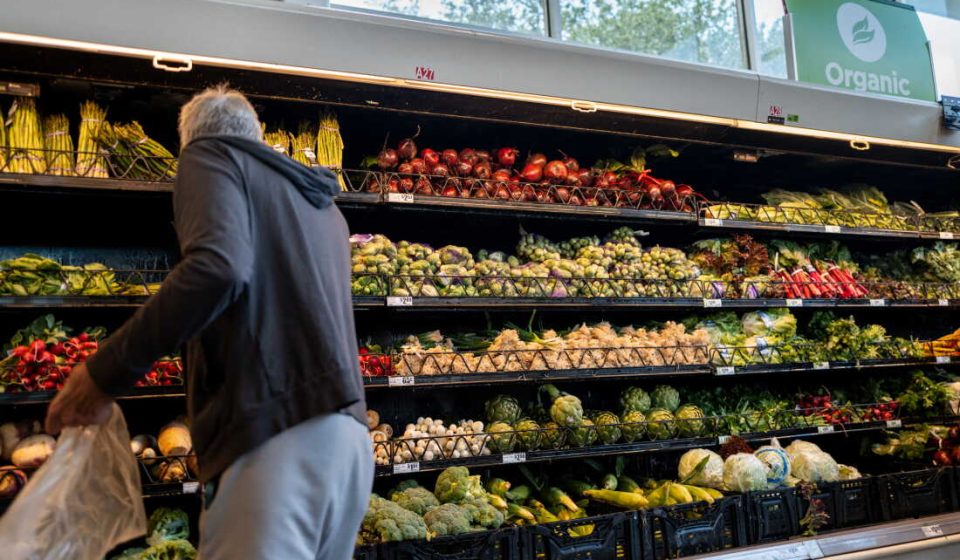


A customer purchases produce at an HEB grocery store in Austin, Texas on May 11.
Brandon Bell/Getty Images
hide caption
toggle caption
Brandon Bell/Getty Images
The Supplemental Nutrition Assistance Program (SNAP) is undergoing a radical restructuring of its funding model – one that will reduce federal support and force states to foot more of the bill.

Historically, the federal government and states have equally shared operational costs of the food assistance program, such as paying state workers and training staff. But starting Thursday, states will have to cover 75% of that bill while federal funding will cut in half.
By the federal government’s own calculations, the new rule will result in a $16.9 billion reduction in federal spending on SNAP over the next five years, or $3.4 billion per year.
The Food Research & Action Center, an anti-hunger advocacy group, estimates that states would need to raise between $3 million and $670 million to fully offset the loss of federal funding for administrative costs. California, New York, Pennsylvania, Texas and Michigan are expected to be particularly hard hit.
Over the past year, states have rebalanced their budgets to account for new costs. But they will likely have to tighten their belts even more as more funding changes loom on the horizon.
Currently, food benefits are fully covered by federal dollars. But starting in October 2027, states could have to pay a portion of food aid if their error rate — a measure of overpayments and underpayments to SNAP recipients — is at or above 6%.
The Center on Budget and Policy Priorities, a left-leaning think tank, estimates that nearly half of states could each pay $100 million or more if they did not reduce their error rates. California and New York could each have to pay more than $1 billion if they fail to do so, according to the think tank.
In a report released last year, the Georgetown Center on Poverty and Inequality estimated that these changes combined will require states to spend two to three times as much to maintain the food assistance program.
These rising costs will put states in a bind, where they will likely have to find new sources of revenue, reduce funding for other programs or further restrict access to SNAP, according to Katie Bergh, senior policy analyst at the Center on Budget and Policy Priorities.
“And we might see some states decide they need to opt out of the program altogether,” Bergh said.
The funding changes were triggered by President Trump’s domestic policy bill, the One Big Beautiful Bill Act, signed into law in July 2025. The White House said the legislation preserved and strengthened the food assistance program, adding that it was “so bloated that it leaves fewer resources for those who truly need help.”
But Bergh says SNAP’s previous funding structure had been helpful.
“This essentially ensured that eligible families seeking benefits could get them even if they lived in a state with much higher poverty rates or a smaller tax base,” she says.
The Department of Agriculture, which administers SNAP, has not yet responded to a request for comment.
The One Big Beautiful Bill Act also introduced other sweeping changes, adding stricter work requirements and ending eligibility for food assistance for the small group of noncitizens who previously qualified for it.
Since the start of Trump’s second term, the number of people receiving SNAP benefits has fallen from 42 million to 36 million as of June. Most of this decline occurred after the enactment of the One Big Beautiful Bill.
Gn headline