‘Traffic is going to get a lot worse’: San Francisco Bay Area faces potential mass transit system death spiral | California

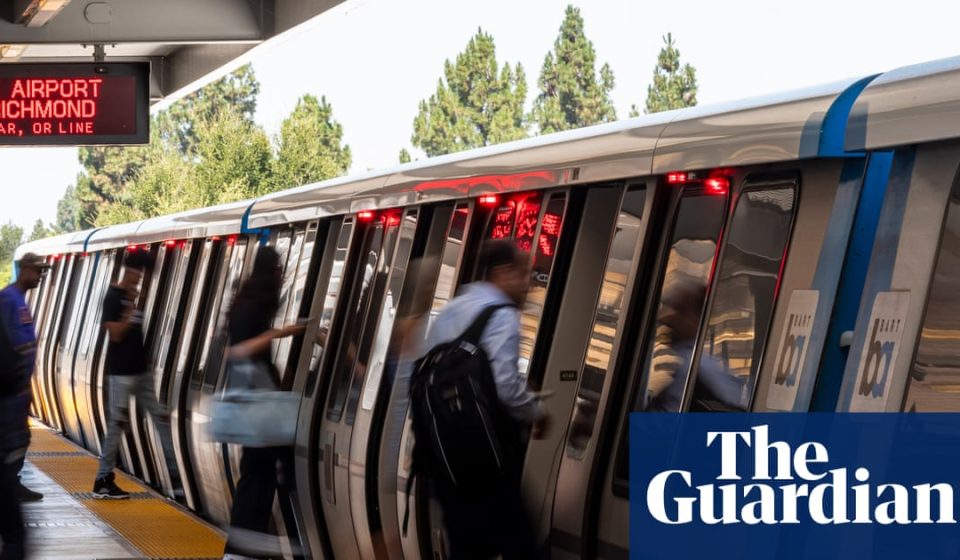
A An engineering marvel and model of sustainable public transportation, the San Francisco Bay Area transit system, struggling financially after years of declining ridership, now faces a fiscal precipice – and a potential death spiral that would have massive repercussions for everyone in the globally influential metropolis.
As early as early 2027, Bay Area Rapid Transit could be forced to close up to 15 stations, reduce service frequency by 63%, increase the cost of rides and parking fees by 30%, and end all service at 9 p.m. If service becomes less frequent and more expensive, there will be fewer commuters, less fare revenue, and a cascade of financial austerity with ripple effects for all Bay Area residents, not just those who regularly use public transportation.
In a worst-case scenario, the entire system could be deemed unsafe and shut down.
The transit system, known locally as Bart, has served the Bay Area for more than five decades, connecting 50 stations in five counties. Given the region’s sprawling geography, formed around a vast body of water, the region’s highways and bridges are notoriously congested. With 130 miles of track connecting cities like San Francisco and Oakland to the broader South and East Bay regions, Bart allows commuters to bypass congested roads and high bridge tolls.
Bart is also a feat of engineering. Its underwater tunnel, known as the Transbay Tube, lies 41 meters beneath the cold waters of San Francisco Bay. It was designed with flexible joints to absorb seismic activity from the region’s two active fault lines and emerged unscathed from the 1989 earthquake.
Bart is a self-sustaining funding model and was the first American public transportation system made fully accessible to people with disabilities. At its peak in 2016, the agency served 435,000 passengers every weekday and grossed nearly half a billion dollars a year.
But since the pandemic, it has struggled to regain enough passengers to sustain its financing model.
Now its future depends on voters approving a half-cent sales tax in four Bay Area counties and a $0.01 sales tax in San Francisco. The regional transit measure would generate about $1 billion a year to fund the four largest transit operators for 14 years. For San Francisco voters, this is one of two transit taxes scheduled for the November ballot.
“Losing Bart is destroying the Bay Area economy,” said Jeffrey Tumlin, former director of the San Francisco Municipal Transportation Agency (SFMTA), now on sabbatical. “All the major tech companies in the Bay Area and the trade associations that represent them understand that there is no tech economy in the Bay Area without Bart.”
“Traffic is going to get much worse”
On a Wednesday morning, the Yellow Line from Antioch is bustling with commuters relaxing as they fly past traffic. Out the window, the highway is already clogged with cars heading to Oakland, Berkeley, San Francisco and other centers of work and study in a region that is home to more than 7.5 million people.
“Sometimes I sit here on Bart and I look out the window and laugh — ha, ha, ha! — at people in traffic,” said Carissa Spencer, an Airbnb executive assistant in her 40s who takes Bart almost daily from Antioch to downtown San Francisco. The prospect of losing this rail line and finding yourself in a traffic jam seems like a cruel joke.
“It shocks me that this is how we operate in the United States of America in 2026, where people have to have a car to be able to survive,” she said.
As slow as traffic is today, it could more than double if voters reject the ballot measure.
Riding the Red and Yellow Bart lines in the early hours, the Guardian spoke with families and commuters from the far reaches of the Bay Area who rely on the system to take them to schools and jobs at banks, universities, hospitals, tech companies and fast-food chains.
Unlike transit systems in other world-class cities that receive significant government funding, Bart has generated 60% to 70% of its operating revenue through passenger fares, making it uniquely self-sustaining — and particularly exposed to low ridership during the pandemic and the Bay Area’s shift to remote and hybrid work, a national leader.
To attract passengers, the agency improved security, cleaning, restrooms, fare gates and payment systems, while shortening trains, retiring old cars, realigning schedules for off-peak demand and synchronizing operations regionally. Despite delays of several days due to overheating of old equipment earlier this month and the difficult deployment of the new Clipper 2.0 card, Bart has a 95% on-time delivery rate and a record pilot satisfaction rate.
David, 42, a surgeon who takes Bart’s Red Line to work at dawn, supports the ballot measure but would like to see the area’s big businesses that benefit from Bart step up: “I think they should pay part of the subsidy to make our transportation work for them,” he said.
The economic, climate and equity stakes of the failure of both measures at the ballot box could not be higher. A new report from the San Francisco Bay Area Planning and Urban Research Association (Spur), which spearheaded the regional transit measure, paints the bleakest picture yet: Traffic delays on the Bay Bridge and other chokepoints would more than double during rush hour.
“Traffic is going to get a lot worse and I think that’s the best-case scenario,” said Laura Tolkoff, director of transportation policy at Spur and author of the report.
The public transit system is largely what keeps road networks running, and people who can’t transition to cars, including low-income workers and people with disabilities, will be hit hardest.
Alvina, 70, takes Bart every day from Oakland to her job at McDonald’s in Lafayette. If Bart breaks down, she will use Uber, she said in Spanish, which would significantly reduce her hourly wage.
On the Yellow Line between Oakland and Antioch, the Guardian spoke with a half-dozen passengers who made decisions to buy homes or take certain jobs because of the area’s relative affordability and proximity to Bart. Now this segment of the rail could be emptied.
Regina, 34, who studies risk for JP Morgan Chase, said she and her husband bought a house in Antioch three months ago because her job required her to go to the office every day and she hates driving: “The main reason I moved here was knowing there was a Bart line.”
Commuters displaced from public transport to cars would potentially face multiple bottlenecks and would have to travel an additional 10 miles each way to reach an open station, according to Spur estimates. They would also incur about $3,280 a year in additional transportation costs — sales tax, according to Spur, would cost 3 percent of that.
Campaigning for Bart
On a Friday evening in San Francisco’s Sunset neighborhood, nearly three miles from the nearest Bart station, a group of young men with signs, clipboards and polling data went door to door looking for convincing voters.
Anki, a 33-year-old software engineer, spent months meeting strangers at bus stops, at farmers’ markets and at protests to convince them to approve the ballot measures. Motivated by fear of the consequences of budget cuts on himself and on the region as a whole, he gathered a record number of 2,501 signatures to pass the measures in last November’s ballot.
Even if the surveys seem promising, they remain within the margin of error, and he plans to carry out prospecting activities until November, under the first rains of El Niño, if necessary.
“We refuse to wake up in January to creeping highways and stifling bridges, abandoned bus lines and closed Bart stations,” Anki said in a speech launching the final campaign to save public transportation. “We will not stay away from the gates.”
Gn bussni