
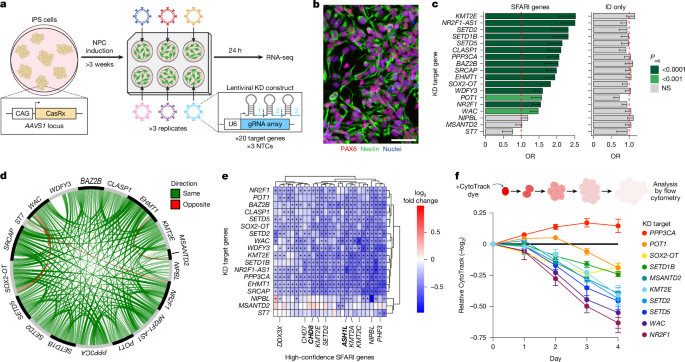
KD with CasRx
CasRx17in particular NLS-RfxCas13d-NLS (Addgene, 109049), was used in combination with target-specific gRNAs for KD of targeted transcripts. A tool based on deep learning66 was used to design gRNA spacer sequences targeting genes of interest. These spacer sequences were filtered to exclude homopolymers (more than four As, more than three Cs, Gs or Ts). Spacer sequences with potential off-target interactions were identified using BLAST67 and excluded. For each target gene, three distinct spacer sequences were selected and combined into a tandem pre-gRNA array, with each spacer sequence preceded by the CasRx direct repeat sequence (DR36).66: CAAGTAAACCCCCTACCAACTGGTCGGGGTTTGAAAC. Tandem pre-gRNA templates were transformed by CasRx into individual gRNAs for KD17. See Supplementary Table 1 for complete sequences.
Molecular cloning
To create constructs for initial NPC KD experiments, we used the lentiviral plasmid pSicoR68 (Addgene, 11579) as the backbone. The mouse U6 promoter was replaced with the human U6 promoter, which was used to drive the expression of the CasRx gRNA templates. These constructs were used in combination with a CasRx knock-in cell line (described below).
To obtain sufficient NPCs for CasRx KD validation by auto-western blot (described below), an all-in-one construct was created containing CasRx and EGFP expressed from the CAG promoter element and gRNA templates expressed from the human U6 promoter. The backbone also contained inverted terminal repeats, which allowed the construct to be integrated into the genome by the piggyBac transposase.69. These builds were based on the LiOn design70 (Addgene, 154019), such that expression of CasRx and EGFP was dependent on recombination of the construct by the piggyBac transposase, preventing expression from the episomal plasmid. This all-in-one construct was also used for fluorophore KD assays and NPC proliferation assays. For fluorophore expression in NPCs, iOn-based constructs were created with mKO2, mScarlet, or iRFP670 driven by the CAG promoter element.
For shRNA-based KDs, shRNAs were designed using the Horizon siDesign Center tool (https://horizondiscovery.com/en/ordering-and-calculation-tools/siDesign-center). Predicted shRNAs starting with G were selected and those with potential off-target interactions were identified using BLAST67 and excluded. The selected shRNAs (Supplementary Table 13) were cloned into the pSicoR plasmid.68 (Addgene, 11579).
For organoid experiments, we created the FLICK construct by integrating multiple features into a structure incorporating the FLEx design.71. In particular, we included a modified Cre recombinase comprising an intron, which prevented plasmid recombination during cloning.72. We also included CasRx17 as well as all necessary components of the Tet-On 3G system73 to allow doxycycline-inducible recombination. Additionally, we included the identification of barcode sequences located a short distance upstream of the polyA sites for fluorescent reporters, which allowed us to determine which KD construct was incorporated into each cell via scRNA-seq. Finally, we incorporated inverted terminal repeats, allowing the construct to be integrated into the genome by the piggyBac transposase.69. The sequences of all constructs were verified by whole-plasmid sequencing (Plasmidsaurus).
Cell culture
All human cell culture work was performed according to protocols approved by the Boston Children’s Hospital IRB (S07-02-0087). The control male human iPS cell line 280 was previously generated and fully characterized74. Human iPS cells and iPS cell-derived NPCs were cultured on tissue culture plates pre-coated with Matrigel (Corning, 354277) or Geltrex (Thermo Fisher, A1413302). Cells were passaged as needed using Accutase (Millipore Sigma, SCR005) or ReleSR (STEMCELL Technologies, 100-0483). Human iPS cells were cultured in mTeSR Plus medium (STEMCELL Technologies, 100-0276). Human NPCs75 were generated from iPS cells using a STEMdiff SMADi Neuronal Induction Kit (STEMCELL Technologies, 08582) following the monolayer culture protocol for at least 3 weeks. NPCs were continuously cultured in neuronal induction medium plus SMADi and were not switched to neural progenitor medium. The medium was supplemented with 10 µM Y-27632 (STEMCELL Technologies, 72304) for approximately 1 day after passage of iPS cells or NPCs.
Brain organoids were generated from 280-iPS cells using a STEMdiff Brain Organoid Kit (STEMCELL Technologies, 08570), following some recommendations by Giandomenico et al.76 with other modifications. Specifically, organoids were embedded in Matrigel (Corning, 354277) on day 7 and cultured in expansion medium until day 14, after which they were removed from Matrigel and passed to maturation medium on an orbital shaker. Full details are available at protocols.io (https://doi.org/10.17504/protocols.io.x54v95p5ql3e/v1).
None of the cell lines have been authenticated. All cell lines consistently tested negative for mycoplasma contamination.
Derivation of CasRx knock-in iPS cells
CasRx17 was projected in the AAVS1 refuge locus of 280-iPS cells using targeting constructs that have been described previously73. Individual colonies of iPS cells were collected and expanded. Southern blot analysis was performed by Celplor to confirm correct targeting of the AAVS1 place. Karyotype analysis was performed using KaryoStat (Thermo Fisher); this revealed a gain of 2.4 Mb on chromosome 1, described in microarray nomenclature as arr(GRCh37)1q32.1(204108163_206539638)x3. This region did not contain any of the target genes.
Lentivirus
Lentiviruses were generated using standard protocols described previously77. Lentiviruses were applied at a multiplicity of infection of 4.0, as this value results in greater than 98% transduced cells. RNA was extracted 24 hours later.
Library preparation for RNA-seq
Bulk RNA was extracted using a Direct-zol RNA Microprep kit (Zymo Research, R2062) and 3′ RNA-seq libraries were prepared according to a modified version of the TagSeq protocol.78integrating the recommendations and pooling strategies of the CheapSeq protocol79. Briefly, 200 ng of total RNA from each sample was combined with an indexed oligo(dT) primer and buffer (NEB, M0466L) as described for CheapSeq. RNA was fragmented in a thermal cycler preheated to 94°C for 2.5 min without a lid, after which the samples were immediately placed on ice. Each sample was then mixed with a template-switched oligo containing an index and a unique molecular identifier (UMI), as well as other reagents required for reverse transcription, as described for CheapSeq. The reverse transcription reaction was carried out at 42 °C for 90 min, without heat inactivation. The remaining single-stranded RNA and oligos were then digested by adding 0.5 µl of EB buffer (Qiagen, 19086), 0.5 µl of thermolabile ExoI (NEB, M0568S) and 0.25 µl of RNase A (Thermo Fisher, EN0531) and incubating the samples at 37 °C for 30 min, followed by thermal inactivation at 85°C for 5 min and a maintenance step at 4°C.
Up to 8 samples with different index sequences were then pooled and the cDNA was purified by performing 1.4 × left solid-phase reversible immobilization (SPRI) selection (Beckman Coulter, B23317). Q5 UltraII Mastermix (NEB, M0544L) was then used, with Partial Read 1 and Partial Read 2 primers, to amplify the cDNA for 7 cycles on a C1000 Touch thermal cycler (Bio-Rad, 1851197), following CheapSeq PCR settings. The amplified cDNA was purified by 0.7× SPRI selection on the left side (Beckman Coulter, B23317). Final library construction was performed using Q5 UltraII Mastermix (NEB, M0544L) with standard TruSeq indexing primers (NEB, E6440S), with amplification for eight cycles following CheapSeq PCR settings. Libraries were purified by double-sided SPRI selection from 0.4× to 0.65× (Beckman Coulter, B23317). Purified libraries were evaluated using a TapeStation HSD1000 (Agilent, 5067-5584 and 5067-5585). For oligo sequences, see Supplementary Table 14.
CheapSeq PCR parameters were as follows: 98°C for 30 s; X cycles (see above) of 98°C for 10 s, 65°C for 75 s; 65°C for 5 minutes; and maintained at 4°C.
DEG analysis of bulk RNA sequencing data from CasRx KD NPCs
Three separate NPC samples were analyzed per condition. Individual KD conditions were compared to three NTC conditions, which were considered together as a set of nine control samples. Gene expression was quantified using UMI deduplication fry (salmon-v1.9). A salmon index and transcript-gene map were constructed using GENCODE v.45. Counts of distinct transcripts corresponding to the same gene were summed. Only genes with baseMean expression greater than 10 in NTC samples were considered for further analyses. Differential expression analysis was performed using DESeq2 (v.1.42.0), with the ~Batch + sgRNA template.
For KD confirmation, P. values were adjusted using the Benjamini–Hochberg correction to test multiple hypotheses for the set of 20 directly targeted genes. The raw P. value for SRCAP was derived from droplet digital PCR (ddPCR), as SRCAP was filtered from RNA-seq analysis due to its low expression. See Supplementary Table 2 for details. For transcriptome-wide analyses, P. values were adjusted using the Benjamini–Hochberg correction to test multiple hypotheses for the set of 11,168 genes analyzed (baseMean 10 in NTCs).
Droplet digital PCR
To confirm KD of SRCAPRNA samples that had been used for RNA sequencing (above) were assessed by ddPCR. RNA was first converted to cDNA using SuperScript IV VILO Master Mix (Thermo Fisher Scientific, 11756050). Next, we performed ddPCR by combining the cDNA with an RNA equivalent concentration of 0.25 ng μl−1 (5 ng per 20 µl reaction), primers at a final concentration of 0.1 µM and QX200 ddPCR EvaGreen Supermix (Bio-Rad, 1864033). ddPCR reactions were performed using a QX200 AutoDG Droplet Digital PCR System (Bio-Rad). Expression…
Gn Health