
U.S. Treasury Secretary Scott Bessent speaks during a press conference at the Treasury Department’s Cash Room in Washington, as he announces a new round of sanctions against Iran, August 24, 2026.
Mehmet Eser | Anadolu | Getty Images
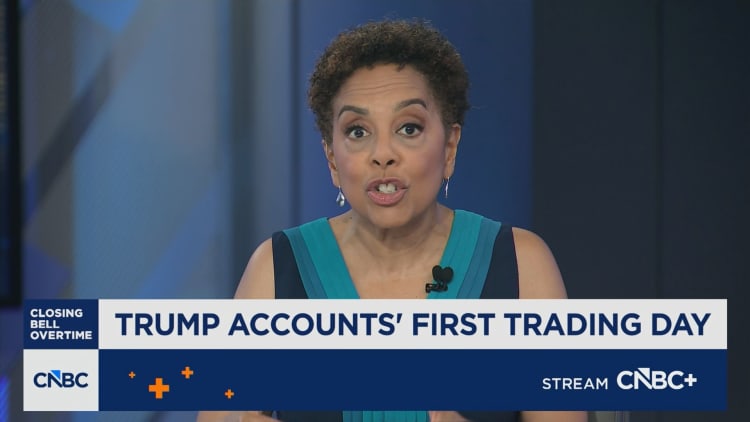
More than 60 million U.S. children under the age of 18 have been automatically enrolled in Trump accounts, the U.S. Treasury Department said Thursday in an announcement provided exclusively to CNBC.
Treasury proposed regulations Tuesday to begin the automatic enrollment process for millions of children this week. As of Thursday, the process was complete, according to the agency.
Trump accounts, also known as 530A accounts, were officially launched on July 4 and are open to any American child under the age of 18 with a Social Security number. Children born between 2025 and 2028 can also apply to Treasury for a one-time contribution of $1,000 to the pilot program.
“Millions of children have already signed up for Trump accounts. With automatic enrollment, more than 60 million additional eligible children now have accounts ready to claim,” Treasury Secretary Scott Bessent said.
Treasury will also allow stock donations to Trump accounts, which could boost “large-scale private donations,” according to temporary regulations released this week.
“Wealthy founders and shareholders have pushed to donate shares directly” because it avoids capital gains taxes triggered by selling and donating money, said Ben Henry-Moreland, a certified financial planner with advisor platform Kitces.com.
Notably, the update allows Trump accounts to hold given individual stocks, a change from previous guidelines that allowed only diversified, low-cost funds. Donated shares generally must be held for five years before being sold, according to Treasury.
The latest news from the Trump accounts comes about a month before the midterm elections, as Republicans struggle to defend their slim margins in the House and Senate.
Here’s what parents should do
Auto-enrollment alone will not trigger the $1,000 deposit. Families must still choose to receive the government start-up money if their children are eligible, according to regulations released Tuesday.
“Children eligible for the $1,000 government pilot contribution will not automatically receive this contribution,” Henry-Moreland told CNBC.
To claim the account, parents or guardians must download the Trump Accounts app, verify their identity and relationship to the child, review the account information and agree to the account terms, according to Treasury.
Eligible children must claim their account to allow contributions from family members, friends and employers, and to receive the one-time $1,000 contribution from the Treasury Department.
Other funds from the Trump Account may also be available, depending on certain criteria. Tech CEO Michael Dell and his wife Susan have committed $6.25 billion to provide an additional $250 to children born between 2016 and 2024 who live in ZIP codes where the median income is $150,000 or less. These funds are specifically intended for low-income children.
“The regulations essentially introduce the idea of automatic accounts, created for every child under 18 who has a Social Security number,” said Madeline Brown, senior policy associate at the Urban Institute, a Washington-based think tank. “This means kids won’t miss out on philanthropic gifts, like the Dell money, or growth on those gifts, even if no account has been activated for them.”
However, “this will still require families to ultimately claim their children’s accounts, and we don’t have many details on how that process will play out,” she added.
Because Trump accounts previously required families to “opt in,” widespread participation was difficult, especially among lower-income households, according to Brown.
“The proposed regulations mark an important step toward automatic enrollment, bringing account design closer to the evidence base to increase participation,” she said. “This change is particularly important given the low participation rates we have seen so far under the opt-in structure.”
As of mid-September, about 7 to 8 million U.S. children had opened Trump accounts, Bessent said during a hearing by the House Financial Services Committee.
“Window of opportunity” for parents
The new national auto-enrollment policy, coupled with significant federal and private funding, has created “a window of opportunity,” said Timothy Flacke, CEO of Commonwealth, a national nonprofit.
Before the auto-enrollment provision, only 5 percent of low- and moderate-income families had opened a Trump account, according to a recent Commonwealth report.
The Commonwealth survey, of almost 1,100 low- and middle-income parents of children aged 10 and under, found that concerns about tax implications, the impact on public benefits and the inability to contribute to the new investment accounts were major barriers.
For the Commonwealth’s analysis, low- and moderate-income households are those earning up to $80,000 a year, a threshold below last year’s median household income, which was $87,460, according to the latest Census Bureau data. The Commonwealth survey, conducted in July, had a margin of error of plus or minus 3%.

For some families, questions about eligibility, contribution limits, and withdrawal restrictions were likely to discourage participation, “particularly among households with limited time, weak financial literacy, or insufficient outside savings for emergencies,” according to a June 9 policy analysis by Adam Michel, director of tax policy studies at the Cato Institute, a Washington-based libertarian think tank.
“The result is a system used primarily by those best equipped to navigate it,” he writes.
Low-income people often face barriers to accessing government programs, Omeed Firouzi, professor of practice and director of the Low-Income Taxpayer Clinic at Temple University’s Beasley School of Law, told CNBC.
Many low-income households “don’t have the time or resources to hire people to handle all of this for them,” he said.
Families could still miss out on $2.88 billion
In the United States, about 14.4 million children of all income levels, born between 2025 and 2028, are expected to be eligible for the $1,000 federal start-up funding, according to a Commonwealth study. Among them, 5.8 million belong to low or moderate income households.
Based on historical participation rates for the federal Earned Income Tax Credit, about 20% of eligible babies may not claim their $1,000 deposit, the Commonwealth found.
The Earned Income Tax Credit, or EITC, is designed to support low- and moderate-income families by reducing the amount of tax they owe. Since it is a refundable tax credit, eligible taxpayers can receive a refund even if they owe little or no federal income tax.
But many filers don’t claim it because of “complicated rules” that can be “restrictive and burdensome,” among other reasons, according to Temple University’s Firouzi. Nearly one in five eligible taxpayers missed out on the EITC, which averaged $2,916 for 2024 returns among those who claimed it, the IRS said earlier this year.
For the Trump accounts, a similar take-up rate would amount to about $2.88 billion in federal start-up dollars that children living with low or moderate incomes stand to miss out on during the pilot phase, according to the Commonwealth’s analysis.
However, “part of the value here is not just the money,” said the Commonwealth’s Flacke; it is “the power of knowing that the money is there, of watching it grow, and of carrying with you the feeling that there is a financial future.”
Subscribe to CNBC on YouTube.
Gn bussni