WASHINGTON- The day before the midterm elections, Trump administration lawyers asked the Supreme Court to step in and throw out the ballots of 20,000 California voters who the administration says may not be citizens.
“The Court should issue a limited injunction ordering California to stop mixing alleged illegal ballots with legal ballots, pending the completion of the United States’ appeal to the 9th Circuit and further review by this Court,” Attorney General D. John Sauer wrote in an emergency appeal filed Monday.
He said the court should require “that California segregate mail-in ballots from individuals the United States has identified as likely noncitizens. The court should also issue an administrative injunction to that effect while it considers this request.”
It is unclear whether the court will consider this an emergency.
The appeal goes first to Justice Elena Kagan. She could request a response from California, which would take days.
So far, the administration has lost before a federal judge in Los Angeles and twice before the 9th Circuit Court of Appeals in San Francisco.
These judges said President Trump’s lawyers got the Constitution wrong and their complaint came too late for this election.
California Gov. Gavin Newsom blasted the administration’s appeal after repeatedly being denied relief sought in lower courts as baseless, and the government’s emergency claim as dubious given its own actions in recent days.
“Trump and his administration have never understood what ‘NO’ means, and it seems that after being told ‘NO’ three times in the last week, they still aren’t sure. After waiting over three days on this, they are now asking for ’emergency’ aid on the eve of the election,” Newsom wrote on X. “Just another reason why their claims are false.”
As of May, more than 23 million Californians were registered to vote, and the majority lean toward Democrats. But Trump again claimed last week that “there are hundreds of thousands of bad ballots, bad votes, in California. Millions, in my opinion.”
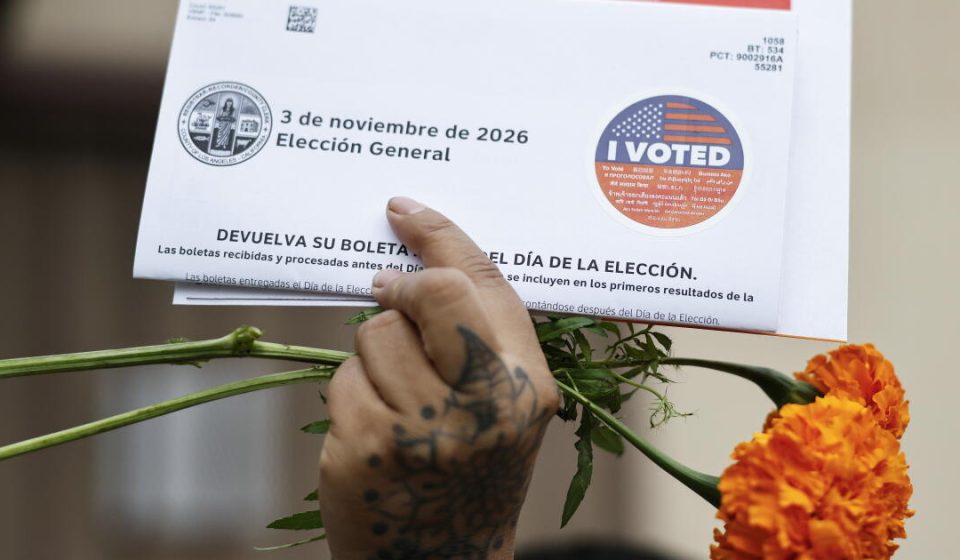
More than 6.4 million ballots had already been cast as of Sunday, according to California Secretary of State Shirley Weber’s office. These ballots are already counted, according to California law.
In mid-October, the Trump administration filed a lawsuit and said federal courts should require California and Los Angeles County to “scind the mail-in ballots of federally identified individuals who may be noncitizens.”
The suit was filed just days after Justice Department officials gave Weber and Los Angeles County Registrar/Clerk Dean Logan a 48-hour deadline to begin cooperating with federal authorities to void the ballots of about 20,000 voters who the administration had determined might not be citizens.
Weber, Logan and a host of other voter advocacy groups and election experts have questioned the reliability of the administration’s list, which was compiled using a mix of election data purchased in California and scraped from commercial platforms, according to administration officials.
County officials and analysts with UCLA’s Voting Rights Project said the lists contained U.S. citizens and others who are not registered voters.
Los Angeles County officials said a review of a subset of 200 voter registrations on the 20,000-person list found that nearly 40% appeared to be born in the United States and 71.2% had never voted. A UCLA analysis of the 20,000 names found that more than 4 in 10 names were not on California’s current voter list.
The state’s lawyers argued that it would be impossible to comply with the administration’s demands while voting is already underway without causing widespread voting disruptions, and would disenfranchise legitimate voters wrongly registered on the administration’s unreliable rolls.
Justice Department officials stressed that they were only asking that flagged voters’ ballots be voided while state and federal authorities worked together to determine whether the voters were citizens — something they said could be accomplished relatively quickly if the state simply complied with its requests to collaborate.
They also said emergency court intervention was needed because California law allows ballots to be counted before Election Day, and once a ballot is cast in person or removed from its mailing envelope, it cannot be separated from the vote total.
Federal law states that within 90 days of an election, authorities cannot “systematically remove the names of ineligible voters from the official lists of eligible voters.”
Separately, the Supreme Court has also repeatedly disapproved of “last-minute court-ordered changes” regarding elections.
The California court cases have highlighted the divide between the state and federal government when it comes to election law.
Usually, federal laws are considered the “supreme law” and take precedence over conflicting state laws. No one disputes that U.S. prosecutors can bring criminal fraud charges against noncitizens who violate a federal law by registering in a state to vote and voting illegally.
But the election rules and procedures are different. The Constitution provides that “the times, places, and manner of holding elections for senators and representatives, shall be prescribed in each State,” unless Congress acts by legislation to “alter” its regulations.
The 9th Circuit judges said in their Friday opinion that “this clause expressly dictates which sovereign has the authority to prescribe the manner in which congressional elections will be conducted.”
“If the United States believes that different procedures are necessary for mail voting, we believe it should take that suggestion to Congress, not to the courts,” said Justices Mark J. Bennett, a Trump appointee, and Gabriel P. Sanchez, a Biden appointee.
Dissenting Justice Patrick J. Bumatay, a Trump appointee, called the administration’s proposal to separate the 20,000 ballots a “reasonable request” and a “modest remedy” to the problem of illegal voting.
The majority cited a 2013 opinion written by the late Justice Antonin Scalia.
“The Elections Clause functions as a default provision,” he wrote. “This gives states responsibility for the mechanics of congressional elections,” unless Congress adopts a different rule.
Scalia spoke on behalf of a 7-2 majority that rejected an Arizona law requiring voters to show documentary proof of their citizenship when registering to vote. In the National Voter Registration Act of 1993, Congress declared that voters can register to vote by filling out a form and swearing under oath that they are citizens.
California does the same under state law.
Scalia said federal voter registration law does not allow Arizona to adopt new, stricter rules.
In dissent, conservative Justices Clarence Thomas and Samuel A. Alito Jr. said they would go further to protect states from federal election interference.
“Given the states’ exclusive authority to set voter qualifications and determine whether those qualifications are met,” Thomas said, Arizona’s restriction should have stood.
“The Constitution reserves for the states the power to decide who is eligible to vote in federal elections,” Alito added.
Last month, Trump prosecutors brought fraud charges against 28 legal immigrants in California who allegedly registered or voted in the past even though they are not citizens. They did so under a 1996 immigration law that bars any foreigner from voting in federal elections.
Acting Deputy Atty. Gen. Trent McCotter, in an article published Monday on X, wrote that California “has refused to work with the federal government to protect against non-citizen voting, which dilutes legal votes.”
“We will continue to use all available legal avenues to protect the integrity of our elections and ensure the enforcement of federal law,” he wrote.
Election law experts were quick to criticize the Justice Department’s intervention.
“The Supreme Court should and I believe will reject the administration’s last-minute, nervous attempts to interfere in California’s elections,” said Walter Olson of the libertarian Cato Institute. “Mar-a-Lago, which has taken the lead on this issue, needs to get this across its head: Unless and until Congress provides clear legal guidance to the contrary, the Constitution reserves these decisions for the states.”
The notion of segregating potentially suspect ballots is not a new issue for the Supreme Court.
In November 2020, Alito agreed with Pennsylvania state officials and said they should set aside late-arriving mail-in ballots to be counted separately.
In response to the COVID-19 pandemic, state election officials and the state Supreme Court agreed to waive part of state law and allow the counting of mail-in ballots that arrived up to three days late.
Republicans strongly opposed it. This led to Alito’s order. But in the end, the small number of late votes made no difference as the Democratic nominee, former Vice President Joe Biden, decisively won Pennsylvania’s votes and beat Trump.
The California dispute is different because the state has not changed its voting rules or election procedures. Instead, it was the Trump administration that sought belated changes to voting rules and election procedures in California.
Gn usa