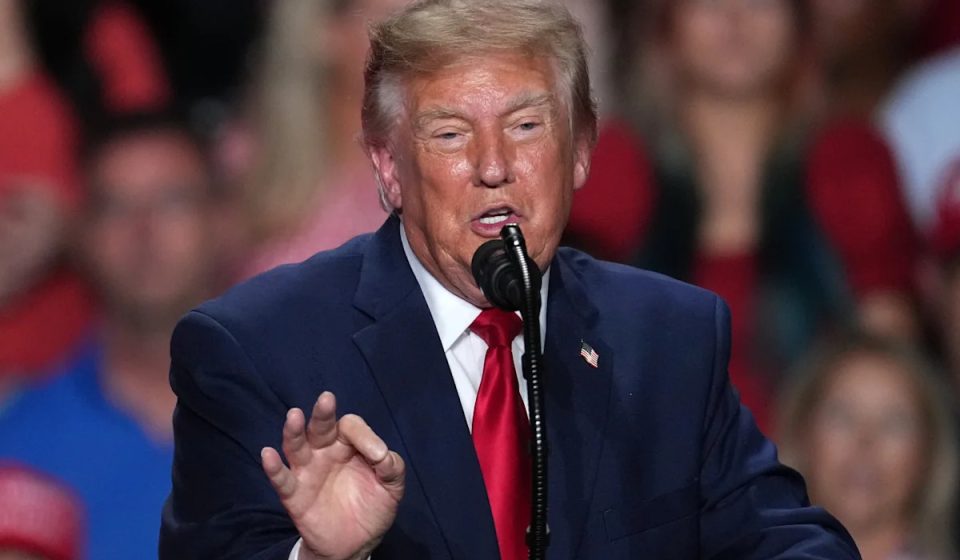

President Donald Trump bet that importing more beef would lower prices enough to soften the political blow for angry ranchers.
His bet was not rewarded.
Prices have barely budged, ranchers remain furious and vulnerable Republicans in Iowa, Kansas, Nebraska and Texas are fighting to convince rural voters to turn out in November as farmers face economic headwinds fueled by the president’s policies.
“There’s a lot of frustration and anger,” said Glenn Brunkow, president of the nonpartisan Kansas Farm Bureau and a fifth-generation farmer and rancher in deep-red Pottawatomie County.
The president’s proclamation in August temporarily allowing imports of cheaper beef from countries like Brazil knocked $200 to $400 off the value of a U.S. cow, he said, which would otherwise sell for about $2,000.
“We knew it wouldn’t have much effect on the price of hamburgers in stores. But the markets welcomed this news and it really brought down the price we get for our cattle,” Brunkow said.
“Then give us $6 diesel. That was pretty hard to swallow.”
Republicans in major beef-producing states, agriculture industry representatives and administration officials, including Agriculture Secretary Brooke Rollins, have warned Trump that his plan to import beef would hurt ranchers and jeopardize Republican candidates. Those fears are coming to fruition just weeks before what appears to be a bruising midterm election for the Republican Party, as declining profits add to the frustration of voters who have long been a reliable part of the Republican base.
“It wasn’t worth it and what it did to the market,” said Jenna Stanton, director of federal policy at Western Skies Strategies. “He’s doing exactly what we thought he would do, which was nothing.”
Incumbent Republicans, including Sens. Pete Ricketts of Nebraska and Roger Marshall of Kansas, now face surprisingly competitive races, while Texas Attorney General Ken Paxton and Iowa Rep. Ashley Hinson are behind in elections for critical Senate seats that the GOP cannot afford to lose.
White House spokeswoman Anna Kelly said in a statement that Trump had “done more than anyone for American agriculture” through new trade deals, tackling high production costs and investing heavily in programs for farmers through the Republican megabill.
“At the same time, he delivers on his promise to consumers by reducing beef prices while allowing our U.S. cattle herd to grow,” Kelly said. “The President will continue to take action to support our great farmers while promoting economic prosperity for all Americans.”
The president’s proclamation included a provision that allows the administration to suspend duty-free beef imports if food prices do not decline. Some of the president’s advisers have privately echoed calls from the powerful American Farm Bureau Federation and other industry groups to reconsider the plan.
“There is still time to revisit this situation,” said John Newton, Farm Bureau vice president of public policy and economic analysis. “The communication has been clear from ranchers, from Capitol Hill, across the country. It’s been received equally. I know the White House sees it. They don’t have their heads in the sand.”
Trump is not backing down. The White House is not currently considering scaling back or ending the proclamation, which would allow it to expire as scheduled in November, according to two people familiar with the plan who were granted anonymity to discuss it.
“I did this little thing because I think it’s very important and it’s over very quickly. And I’m not looking to renew it, but I want them to produce more,” Trump told News Channel Nebraska on Monday, while once again defending his decision in the name of lower prices.
“This has really become unacceptable to voters and we need to be elected,” Trump added. “Because if we don’t get elected, your ranchers and farmers are going to be in big trouble – if the Democrats come into power.”
Trump’s proclamation encouraged grocery stores to sell the newly imported beef at a 25% discount, but the American Farm Bureau Federation found that ground beef prices overall had fallen only about 2% at the 41 grocery stores tracked by its economists in 22 states. In 30 of these stores, the price remained the same.
Nationally, the average price of ground beef was $6.92 per pound in August, compared to $5.55 when Trump returned to the White House.
Any slight drop in prices could potentially be reflected in federal data to be released next week, but likely won’t go beyond normal price fluctuations, economists say. That’s unlikely to do much to assuage voters’ broader concerns about the cost of living.
Sen. Cynthia Lummis (R-Wyo.) told POLITICO she still hears from frustrated ranchers in her home state.
“It doesn’t help the price of beef at the grocery store,” Lummis said, calling Trump’s proclamation “somewhat counterproductive” and advising the White House to focus instead on the power of meatpackers that influence prices.
In some cases, the damage has already been done for agricultural states. The administration can cite little immediate impact for consumers to justify the losses suffered by ranchers, while analysts struggle to determine the true scope of the proclamation and its impact on grocery stores. And the move sent the wrong message to ranchers, who must make crucial decisions about whether to cull or retain cattle to expand their herds next year, according to economists and industry executives.
“I just think it’s had a limited impact on consumer behavior, a limited impact on family budgets. And it’s had a significant negative impact on producers” who are looking to replenish their herds, said a person close to the administration, who requested anonymity to speak candidly about their frustration. “I hope a lesson has been learned here.”
Gn bussni