U.S. President Donald Trump speaks with Meta CEO Mark Zuckerberg in the aisle of the White House following a luncheon for technology executives in the East Room, in Washington, DC, U.S., September 29, 2026.
Kevin Lamarque | Reuters
A month after President Donald Trump ordered the term “super intelligence” to replace artificial intelligence within executive branch departments and agencies, his top tech allies — Elon Musk and Mark Zuckerberg — followed suit during earnings calls. Their fellow tech CEOs were less eager to do the same.
Trump’s statement came on September 29, as he hosted an AI luncheon at the White House for industry leaders. At the time, he was working to ensure the growth of AI in the United States with limited regulations. The president announced this week on Truth Social that he was banning the use of AI or artificial intelligence in “all relevant documents” and “everything else.”
EspaceX And Tesla adhered to Trump’s wishes during earnings calls last week after Musk, earlier in October, changed the name of his rocket company’s AI division to SpaceXSI. Speaking about Tesla’s call for its work on humanoid robots, Musk said: “Some of them look very impressive, but they don’t really use advanced AI or IS.”
Zuckerberg was also compliant during Meta’s Oct. 21 earnings call, emphasizing his company’s “goal of delivering personal superintelligence to everyone.” However, Meta was already using the term, having established a unit called Meta Superintelligence Labs last year.
While Musk and Zuckerberg may have been the Trump administration’s strongest supporters among tech CEOs, they are by no means exceptions. Executives from every tech giant contributed to Trump’s inauguration festivities or his plan for the White House ballroom, and some have been intent on getting rid of diversity, equity, and inclusion (DEI) programs that the president has opposed.
But for now at least, they are resisting when it comes to eliminating the term AI.
Amazon CEO Andy Jassy peppered his call with the use of AI on Thursday, saying the acronym more than a dozen times in his introductory remarks. A day earlier, Microsoft CEO Satya Nadella said one of the company’s three focuses is “designing AI to empower people.” And Alphabet CEO Sundar Pichai was seconds away from commenting on the quarterly results when he said the search giant’s “investments in AI are driving increased usage and overall user growth.”
Trump’s attempted rebranding comes just before next week’s midterm elections, with the Republican Party at risk of losing control of the House and Senate. Trump’s job approval has plummeted and his economic approval rating just hit an all-time low, according to the latest CNBC All-America economic survey released last week.
“Concrete results”
That’s not to say that tech executives who are sticking to “AI” on this week’s earnings calls are openly defying the president. Trump’s preferred term seeps into other correspondence and documents. Microsoft’s annual report filed last week included eight mentions of superintelligence, starting at the top of the letter to shareholders.
“For Microsoft, the central question as we enter the era of superintelligence is not only how big the opportunity is, but also how we can achieve the real-world results that every country, community, and business demands and deserves,” Nadella wrote.
IBM CEO Arvind Krishna, who did not attend Trump’s September lunch, used IS alongside AI during his company’s earnings conference call last week. Krishna said, “Technological innovation in hybrid infrastructure and super intelligence leads to better business performance,” adding that IBM is moving forward as a “hybrid cloud and software-led AI platform company.”
Chipmaker CEO Lip-Bu Tan Intelsaid Thursday that the supply shortage facing the chip industry is “driven by the unprecedented demand for super intelligence.”

Some in the tech industry have made clear their support for Trump’s terminology ahead of their upcoming earnings reports next month.
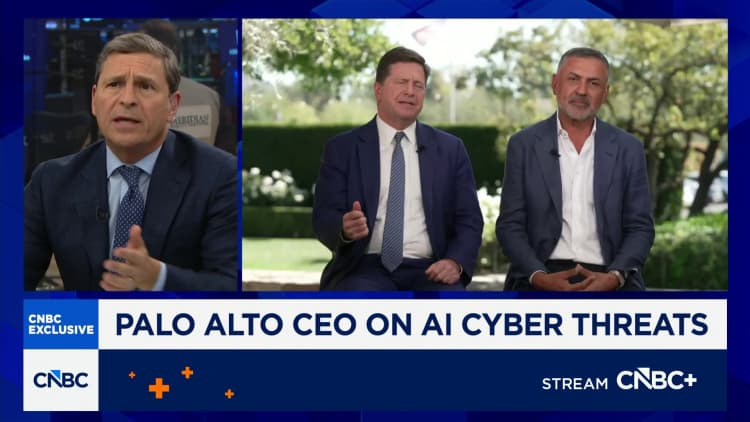
Palo Alto Networks CEO Nikesh Arora repeatedly referenced SI on CNBC and posted on X on September 30: “The meeting at WH on SI was an epic moment. »
Then there is from Nvidia Jensen Huang, who runs the world’s most valuable company and the chipmaker that has fueled much of the AI boom. Along with Musk and Zuckerberg, Huang has been one of Trump’s strongest supporters in tech and the president’s main ally in the AI safety debate.
Like Arora, Huang spoke to X after last month’s AI meeting to praise the “White House Super Intelligence Accord.”
“Superintelligence offers an extraordinary opportunity to advance discovery, productivity, security, health and prosperity,” Huang wrote. “The future of Super Intelligence will be shaped not only by what it can do, but also by the trust it inspires.”
WATCH: Altimeter’s Brad Gerstner on AI

Gn headline