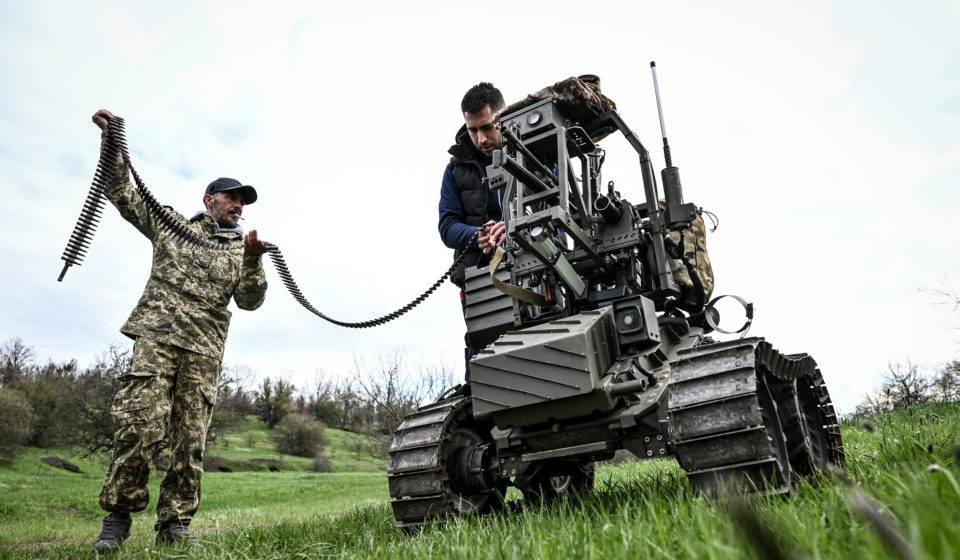

A soldier with the call sign “Italian” and design engineer Denys load a machine gun mounted on a ground robotic complex during testing at a training ground April 10, 2026.
Nuphoto | Nuphoto | Getty Images
A surprise Ukrainian robot offensive in the eastern Donbass region appears to have reversed more than a year of Russian territorial gains, security experts say, dealing a strategic blow to Russian President Vladimir Putin’s territorial ambitions.
Details of Ukraine’s counter-offensive, dubbed “Operation Vivaldi”, have begun to emerge in recent weeks, offering a rare glimpse into the changing nature of frontline combat operations against the backdrop of Russia’s full-scale invasion.
As part of the ongoing operation, which began in May, security experts said Ukraine’s Third Army Corps was able to deploy large bomber drones and remotely controlled robots behind enemy lines around Lyman in northern Donetsk Oblast, apparently taking Russian forces by surprise.
Russian forces have for 12 months sought to encircle towns in Ukraine’s fortress belt which constitute the last territory under Ukrainian control in the region.
The third phase of Operation Vivaldi, however, liberated an additional 51 square kilometers, bringing the total area of reconquered territory to 176 square kilometers, Ukrainian Brigadier General Andrii Biletskyi said on September 28. The final phase of the fighting inflicted more than 2,000 Russian casualties, with more than 250 Russian soldiers taken prisoner, he added.
The experience of Operation “Vivaldi” demonstrated that the systematic replacement of human personnel by robots changes the paradigm of modern warfare.
Serhii Kuzan
President of the Ukrainian Center for Security and Cooperation
Patrick Bolder, a defense expert and strategic advisor at the Hague Center for Strategic Studies (HCSS), described the offensive as a “bloody nose” to Putin’s minimal war goal of seizing Ukraine’s Donbass region.
In addition to demonstrating their ability to keep details of the operation secret, carry out disinformation campaigns against Russia and orchestrate a months-long air operation to disrupt logistical supplies to the front line, Bolder said Ukrainian forces managed to secure air control in the Lyman region, denying Russia the use of its drones.
Ukrainian forces were then able to deploy their own drones to drop unmanned ground vehicles behind enemy lines to attack Russian troops from behind, Bolder said, without endangering their own personnel.
“They put this together masterfully,” Bolder said.
In this photograph distributed by Russian state agency Sputnik, Russian President Vladimir Putin meets with the Moscow-installed leader of the Russian-controlled parts of the Zaporizhzhia region, at the Moscow Kremlin, July 20, 2026.
Alexander Kazakov | Afp | Getty Images
For the Kremlin, “the conquest of Donbass is very far away at the moment because the Ukrainians are now in better defensible positions – which will make it more difficult for the Russians to try to do it again,” he added.
A spokesperson for the Russian Embassy in London was not available for comment when contacted by CNBC on Friday.
“A powerful message for Moscow and Kyiv’s partners”
Security experts have made it clear that Ukraine’s robotic offensive should not be seen as a breakthrough.
However, it sends “a powerful message to Moscow and kyiv’s partners that Ukraine’s highly innovative military remains capable of defeating Russia on the battlefield,” according to David Kirichenko, a research associate at the Henry Jackson Society, a UK-based national security think tank.
Ukrainian President Volodymyr Zelenskyy praised the success of Ukraine’s Third Army Corps during his meeting with soldiers leading the counteroffensive, calling the operation “important in many ways” for the defense of Ukraine as a whole, and the Donbass region in particular.
“A particularly promising area now is replacing our warriors with ground-based robotic systems whenever possible,” Zelenskyy said in a social media post on September 30.
“Under Vivaldi, this capability has allowed us to accomplish a lot. We will expand it so that, more and more often, a drone rather than a warrior carries out the most dangerous tasks on the front,” he added.
Russia has stepped up its attacks on Ukraine’s capital and major cities in recent days, targeting data centers, communications and energy infrastructure, in a bid to disrupt the flow of information and impose power cuts ahead of winter.
Ukrainian officials have expressed deep concern over the attacks, saying it is urgent for the country to be able to quickly respond to missile and drone threats.
Ukraine, for its part, has sought to increase the cost of Russia’s war against it for more than four and a half years, by targeting the country’s oil refineries and logistics centers.
“Changing the paradigm of modern warfare”
Robotic systems have become one of the key factors in Ukraine’s counter-offensive operations, according to Serhii Kuzan, president of the Kyiv-based Ukrainian Center for Security and Cooperation think tank.
“Their use has not only reduced risks to personnel, but also changed the very logic of combat: where previously dozens or hundreds of troops were needed, remotely controlled platforms are increasingly being deployed,” Kuzan told CNBC via email.
“The experience of Operation “Vivaldi” demonstrated that the systematic replacement of human personnel with robots changes the paradigm of modern warfare, making it possible to accomplish tasks with minimal personnel losses.”
Anti-drone nets are stretched across major Ukrainian roads and towns in eastern Ukraine and the Donbass region, to protect against Russian FPV (First-Person View) drones that can fly far beyond frontline positions to create a 20-mile-deep kill zone on either side of the front, July 18, 2026 near Izium, Ukraine.
Scott Peterson | Getty Images News | Getty Images
Ultimately, Kuzan said the Ukrainian counteroffensive in the Lyman region was aimed at seizing the initiative on the battlefield, “which will ultimately force the Russian military to abandon the goals set by its political leaders.”
Ukrainian officials reported that Russian political leaders had previously set a goal of seizing the Donetsk region by the end of the year, although the Russian military would now seek to extend the operation until March next year.
“This is due to the fact that, according to Ukrainian intelligence, in the main directions of Kostiantynivka, Sloviansk and Kramatorsk, the Russian army suffers its heaviest losses, accounting for 70-80 percent of all casualties,” Kuzan said.
Gn world