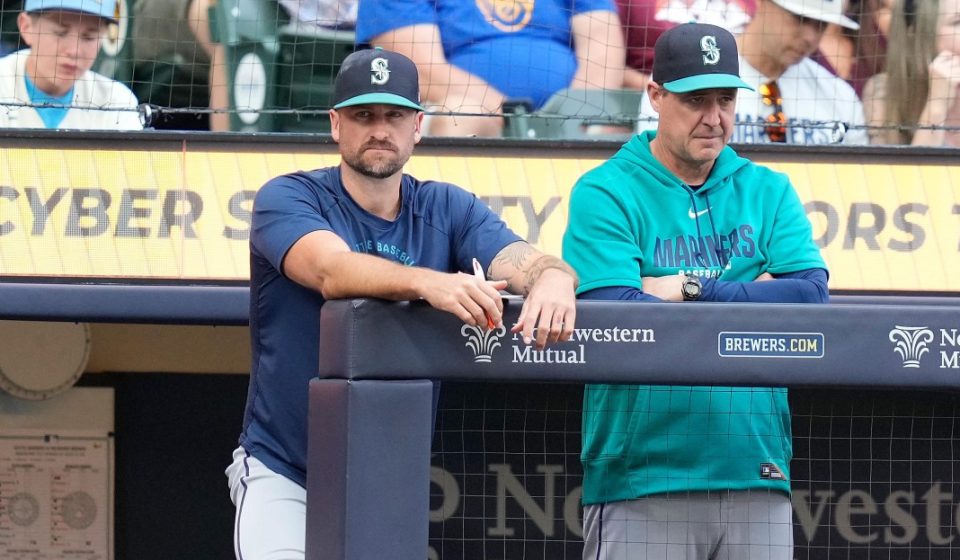
Why the Mariners kept their pitching coaching staff intact despite a rough second-half performance

Yesterday, sweeping changes were made to the Mariners coaching staff following a disappointing 2026 season. Jerry Dipoto, while meeting with the media, described the need for a “cultural reset” within the organization, specifically highlighting the feeling that the major league club had strayed from the organizational principles preached in the minor leagues.
“The performance on the field this year has made us question a lot of the things we do at the major league level, and I will say that several of our major league players who have come through our system have referenced what they learned in player development that was abandoned in the major leagues this year. And not just the players who came in for the first time, but we have a host of players who came through our system and they saw a difference. We have to get back to what we believe be a Mariners baseball process.”
Dipoto expressed particular dismay about the defense – with good reason, since the Mariners were the worst defensive team in baseball throughout, never improving – not only in violating the vision of “clean, efficient Mariners baseball” but also because of the added pressure the poor defense put on pitching.
“A starting pitcher who attacks the strike zone and puts the ball in play suffers from our team’s lack of range and positioning,” Dipoto said.
Perhaps that’s why the pitching coaching staff escaped the ax that fell on many other coaches, as the organization cleaned house so the new manager could install a hand-picked staff. Pitching coaches Pete Woodworth and Trent Blank will both return, despite a pitching staff that also underperformed this year – as the offense began to turn things around late in the season, the rotation collapsed, posting the worst WAR in baseball down the stretch. But despite the setback, Dipoto still believes in the Mariners’ pitching philosophy and Woodworth and Blank’s ability to implement that vision with the big league club. In answering a question about why those two remained on the team, Dipoto cited their past performances, particularly their “goodness over time” and the “unquestionably impressive” nature of the quality of the pitching programs that allowed all 13 members of their pitching staff at any given time to succeed.
“From 2021 through midseason 2026, we’re one of the three or four best pitchers, one through 13, in MLB. We don’t want to take three months and use that as a yardstick to ruin a program that’s been the backbone of what we’ve done for a decade.”
The key to the success of the pitching core, beyond which programs work, is their communication with the players. Dipoto spoke at length about the communication issues within the organization, from the breakdown in expectations of standards within the front office to how that played out in the clubhouse and on the field. Personally, Dipoto took responsibility for his own breakdown in communication with pitchers regarding how the “piggyback” strategy was implemented – while emphasizing that it was in fact a success on the field, he spoke with regret about the failure of how it was communicated to players, and how this breakdown in communication was a sign of a larger organizational failure.
“The way (the piggyback strategy) was communicated, the way it was received, and the drama surrounding it was part of what I think was a bag that we carried with us all year that we couldn’t lose, and the piggyback is a piece of that. I could come up with 10 other factors that contributed, but we need to communicate more clearly. And we talked about it with the players during that piggyback period, that we handled kickoff as bad as possible from a management point of view.
One exception to this organization-wide communication problem is and has been the launch staff, which is why the piggyback drama stood out so clearly. But Dipoto reaffirmed his wholehearted support for Blank and Woodworth as messengers.
“These guys communicate incredibly well,” Dipoto said. “Our pitchers love them for what they provide. Trent has all the TLC in the world and the ability to keep guys healthy and moving forward. And Woody is as good a messenger as there is in this clubhouse space.”
That’s not to say there isn’t work to be done to get pitchers back on track. Cal Raleigh, in his season postmortem, discussed how the Mariners’ pitching may have become too predictable, noting how aggressive he’s seen teams – even ones that typically aren’t – in attacking the first pitch, and saying that pitchers need to do a better job of executing the first strike and think less about throwing the first strike.
“It’s not necessarily always about winning your 0-0s, your 1-1s. It’s about executing a pitch and knowing how to get that guy out,” Cal said.
For Dipoto, the problem wasn’t necessarily the first shot, but the third. Over the course of the season, Mariners pitchers took a moderate step backwards in strikeout percentage and strikeout-to-walk ratio this year, but if you isolate it to just the final two months of the season, Mariners pitchers fell to the middle of the pack in K% and 28th in average allowed – only the A’s and Rockies were worse.
“We’ve had a culture of constantly filling the strike zone. That’s what we do. We move forward, we stay ahead, we work forward,” Dipoto said. “Where we’ve struggled this year is in our two-strike execution, particularly in the second half of the season. It’s something our pitchers are aware of. They’ve all talked about it openly in private discussions, and we know it’s an area we need to focus on moving forward.”
But Dipoto sees this as a fixable problem, not a systemic problem, echoing almost exactly what Cal Raleigh said about over-focusing on winning and losing the big picture.
“It’s something that happened over time. We were so focused on winning our 0-0s and winning our 1-1s that we forgot that it was just a proxy for the bigger goal, which was to finish the at-bat. Our prompt sometimes became the goal, and that’s not what we intended to do. And again, we let it get away from us. And maybe you know, new eyes, new voice, new thoughts can prevent this from happening next time.
It therefore appears that the new manager will also have the task of working with a pitch team already steeped in the organizational culture and helping it refocus. Add it to a long to-do list for whoever that person is.
Gn sports