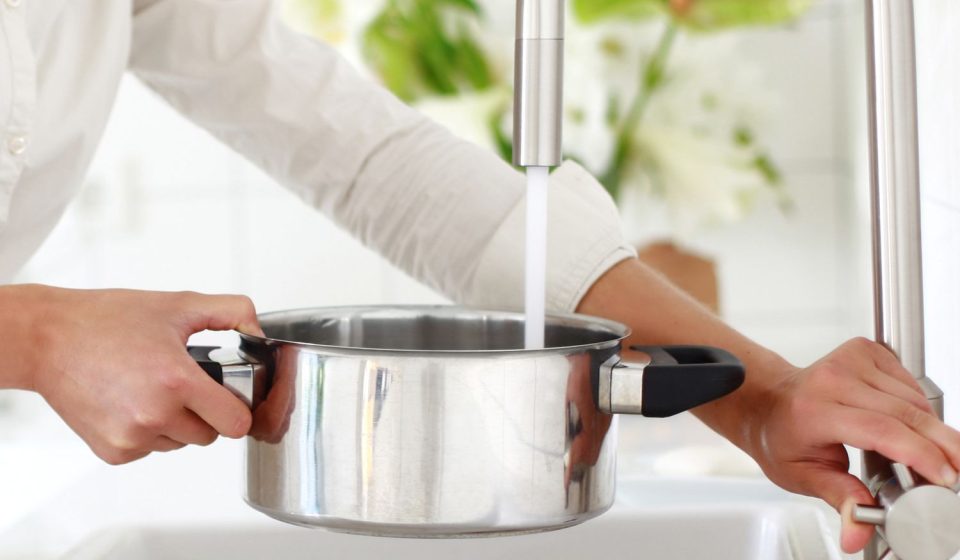

- Starting with cold tap water can reduce lead exposure and help protect children, infants and pregnant women.
- Hot tap water can absorb more lead in the pipes, and boiling does not remove chemical contaminants.
- Run cold water briefly before cooking and use certified filters to further reduce lead in your faucet.
When making rice, soup or pasta, or even a cup of tea, using hot tap water to fill the pot or kettle may seem like an easy shortcut to boiling. It turns out you should never use hot tap water for cooking. Here’s why experts and public health agencies recommend starting with cold tap water instead, regardless of recipe or reason.
- Tracey BrigmanEdD, MS, RDN, LD, clinical associate professor, nutrition specialist and associate director of the National Center for Home Food Preservation at the University of Georgia
- Tetyana Cheairs, MD, MSPHexpert in molecular and environmental toxicology, associate dean for doctoral programs and assistant professor of pathology, microbiology and immunology at New York Medical College, Valhalla, NY
Why cold tap water is safer for cooking
“When using water for cooking, it is recommended to start with cold water,” says Tracey Brigman, EdD, MS, RDN, LD. “Hot tap water can contain more minerals and other substances from the pipes as the water circulates,” she says. These substances can potentially impact the taste of food.
Why hot tap water may contain more lead
Lead can enter water through service lines as well as pipes, solder, faucets and fixtures in a building, especially if your home or building is several decades old.
“Lead and other contaminants (e.g., nickel, iron, chromium) can enter tap water from older lead-containing pipes (e.g., in homes built before 1986), brass or chrome-plated faucets and fixtures, and plumbing connected with lead-based solder, especially when these materials are corroded,” says Tetyana Cheairs, MD, MSPH. “Since hot water dissolves lead more easily, cooking with hot tap water increases the risk of contamination and exposure.”
According to the EPA, hot water dissolves lead more quickly than cold water, so it may contain more lead.
Why boiling water doesn’t remove lead
During emergencies, in areas affected by bacterial contamination or flooding, advisories frequently inform residents to boil water. “This creates the misconception that boiling fixes all the water,” says Brigman. “An inorganic element, such as lead, cannot be removed by boiling; instead, the heat will kill living microbes.”
“Although boiling eliminates many disease-causing microorganisms, it does not eliminate lead or other chemical contaminants,” adds Cheairs. “Additionally, some of the water may evaporate during heating or boiling, thereby increasing the lead concentration.”
Health risks from lead exposure
Epidemiologic studies have shown that lead can cause adverse health effects in children and adults at blood lead levels below thresholds established by federal agencies, including the CDC, FDA, and OSHA. Additionally, the CDC states that no safe blood lead levels for children have been identified. .
“Lead exposures are a significant public health problem,” says Cheairs. “Chronic exposure has been associated with learning disabilities, behavioral problems, impaired cognitive development and other adverse effects,” she says. In adults, it can also impact kidney function, high blood pressure, and the nervous system.
Children, infants and pregnant women are particularly vulnerable because lead can interfere with normal neurodevelopment, says Cheairs. Given these concerns, she adds, public health agencies recommend using only cold tap water for drinking, cooking and preparing infant formula.
Can water in newer homes contain lead?
“Homes built after the passage of the 1986 Safe Drinking Water Act amendments generally contain plumbing materials with significantly lower lead levels than older homes,” Cheairs says. The amendments prohibit the use of new lead pipe, solder, and flux in any plumbing in a residential establishment supplying drinking water.
Although not as bothered by the legacy of lead, newer homes are not completely spared. “Traces of lead may still be present in some plumbing components, and contaminants can build up over time in water heaters, storage tanks, pipes and fixtures,” she says.
How to reduce lead in tap water
Several steps can help reduce exposure to heavy metals found in tap water, says Cheairs. To get started, you can install water filters certified for lead reduction. The EPA recommends purchasing point-of-use (POU) filters and faucet-mounted pitchers tested and certified by an accredited third-party certification body to reduce lead.
A field study in Flint, Michigan, where lead-contaminated drinking water set off alarm bells following a 2014 incident, found that when properly certified, installed and replaced, these carbon block filters were effective in reducing lead exposure from drinking water.
You should let the tap water run for 15 to 30 seconds before collecting it for cooking. “This will help remove water from the pipes and potentially remove water that may have absorbed certain metals,” Brigman says. If you’re away on vacation, she adds, it’s recommended to run your water for 2 to 3 minutes.
Gn Health