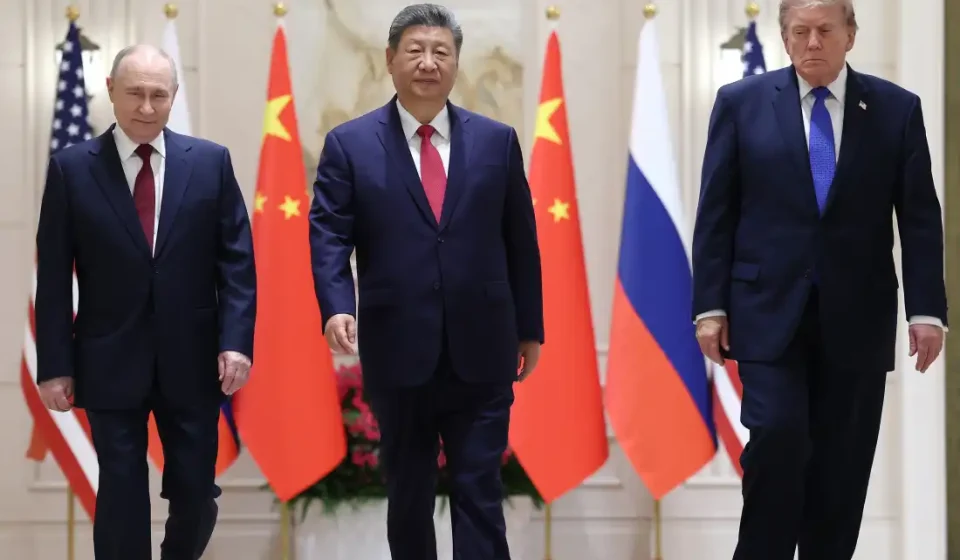

President Trump, right, Chinese President Xi Jinping, center, and Russian President Vladimir Putin arrive for a trilateral meeting at the Kylin Villa in Shenzhen, China, on Thursday.
Win a McNamee/Pool photo via AP
hide caption
Win a McNamee/Pool photo via AP
SHENZHEN, China, and MOSCOW, Russia — President Trump joined Chinese President Xi Jinping and Russian President Vladimir Putin on Thursday for a trilateral summit in Shenzhen, China. Their meeting capped two days of talks characterized by lofty tributes to the role of great powers in maintaining peace, even as some of those powers have played a role in sparking some of the world’s most intractable conflicts.
“History tells us that when great powers are at peace, the world is safe,” Xi said in his opening speech to the cameras. “When great powers clash, the world is in chaos.”
Putin stressed that their nations could make a “significant contribution to strengthening security and stability in the world.”
“In this sense and I think in many other ways, we are making history,” said Trump, who called it a “special responsibility” for the three countries to work together.
Yet they offered few solutions for peace, with leaders presenting divergent agendas:
Trump wanted to talk about reducing nuclear weapons and his mission to prevent Iran from obtaining them; Putin sought to pressure an end to the war in Ukraine on terms favorable to Moscow; Xi meant he hoped to avoid delving into either topic — preferring to highlight China’s growing global influence with more general statements promoting peace and economic stability.
There were also topics to avoid: Trump refused to answer reporters’ questions about China’s alleged role in an espionage plot to smuggle high-end Nvidia chips.
In the end, perhaps the main outcome of the summit was the image itself: the president of the United States meeting with authoritarian leaders from China and Russia for the first time in American history.
Speed dating at the top
Although billed as a summit of “revolutionary significance” by the Chinese hosts, the sit-down discussions between Trump, Xi and Putin were relatively brief – some of that time taken up by interpreters providing simultaneous translation.
The meeting between Trump and Putin lasted 42 minutes. His talks with Xi lasted about an hour. The trilateral group session lasted an hour and a half.

Still, it was enough time for Trump’s familiar bonhomie to emerge.
“Who is he? He’s my friend,” a smiling Trump said upon seeing Putin before their bilateral meeting.
“We’ve known each other for a long time,” Trump added after he and the Russian leader warmly shook hands. “And I think a lot of wonderful things can come from that. Or at least start.”
Trump similarly told Xi: “As long as you and I are in charge of things, we will never have a problem. »
Both statements were tacit admissions that time is running out on Trump’s remaining two years in office — with an even sooner change in Washington when Democrats take control of Congress in January.
Getting there
The gathering in China was first proposed by Putin in a phone call with Trump in October – an offer to meet with President Xi when China hosted the Asia-Pacific Economic Cooperation (APEC) conference in China in November.
For Putin in particular, the meeting was always going to be a coup: the latest sign that – with the help of Trump and Xi – he has effectively undone Western attempts to politically isolate him following his invasion of Ukraine.
Back in Moscow, state media broadcast footage of the three leaders huddled together over and over again – proof that Russia has regained what the Kremlin considers its rightful place among the world’s superpowers.
Pro-Kremlin media ignored hints of more subtle power dynamics at play.
Xi personally welcomed Trump on the tarmac – returning a gesture Trump made to the Chinese leader during his recent visit to Washington – while Putin received a smaller delegation upon his arrival in Shenzhen.
Similarly, Trump was offered the first seat alongside Xi at the APEC group photo and sat next to Xi at the APEC dinner reception – with Putin seated at a separate table.
Was this an insult to Putin? A calculated attempt to flatter Trump? A reflection of a much weaker Russian economy? Whatever the answer, Xi was not completely ignoring his Russian guest.
The two men met privately for two hours on Wednesday – a meeting between China and Russia that observers estimate was their 50th meeting overall.
Xi and Putin have also echoed each other in their public speeches – both touching on familiar themes of the dawn of a new “multipolar world” and criticizing the use of sanctions as a sign of the decline of Western influence.
A new Yalta?
From the start, critics of the summit expressed concern that Trump, Xi and Putin would seek to divide the world within each country’s perceived sphere of influence.
In Russia, the event was billed as a potential “new Yalta” – a reference to a moment in 1945, when the leaders of the United States, the Soviet Union and the United Kingdom hastily agreed on a post-World War II order for Europe.
Instead, the Shenzhen summit reflected the much more fragmented priorities of its participants.
Trump has made no secret that he hopes to include China in arms control negotiations – what Trump calls “denuclearization” – at a time when key nuclear treaties between Russia and the United States have all expired.
The problem: his Chinese hosts had little interest in the question.
Beijing has repeatedly rebuffed US attempts to include it in negotiations with Russia – emphasizing that its arsenal remains far inferior to that of its Cold War-era rivals Moscow and Washington.
A joint statement issued Thursday following the negotiations said the three leaders “reaffirmed that a nuclear war cannot be won and must never be fought.” He said their governments would “conduct a dialogue on reducing nuclear risks and preventing the proliferation of nuclear weapons,” but did not provide a timetable.
The differences also extended to the war in Ukraine, where Putin had hoped to lobby for support from the United States and China for a settlement tilted in Moscow’s favor – including an overhaul of the security map for Europe that would amount to a NATO withdrawal from Eastern Europe.
Xi insisted that Europe would have a seat at the table in any negotiated settlement. Trump has relied heavily on his trusted envoys — real estate developer Steve Witkoff and his son-in-law Jared Kushner — to iron out the complexities of any peace deal.
After the meeting between Trump and Putin, a Kremlin adviser simply said that Ukraine had been at the center of the discussions, adding that the Kremlin leader had left in “an excellent mood.”

It was difficult to understand why.
Hours earlier, Ukraine launched a missile strike for the third time this week on the only bridge connecting mainland Russia to the annexed Crimean peninsula, effectively disabling the structure for months to come.
The bridge is widely seen as the Russian leader’s pet project – a symbol of Russia’s claim to territory illegally seized from Ukraine in 2014, returned in steel.
Additional research by Jasmine Ling.
Gn world