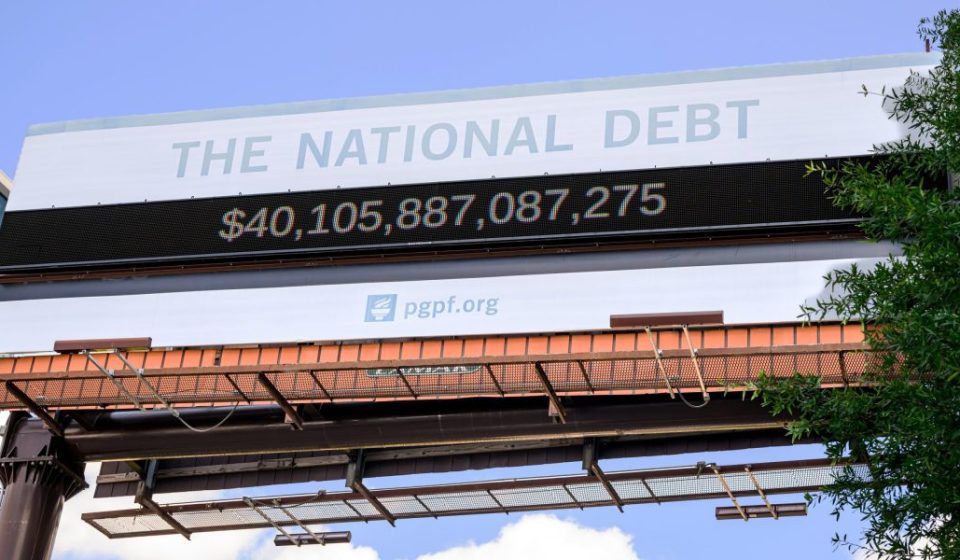
U.S. debt is increasingly at the mercy of the market as interest costs rise as the debt ceiling approaches.

The recent rise in Treasury yields has highlighted how vulnerable the U.S. debt outlook is to the bond market, which Scope Ratings flagged in a new report.
The Europe-based credit rating agency on Friday maintained the U.S. sovereign rating at AA-, three notches below the top rating and two notches below the AA+ ratings of rivals Moody’s, Fitch and S&P Global Ratings.
Scope listed what the United States still has going for it: a strong economy, the dollar as the world’s reserve currency, strong institutions like the Federal Reserve, as well as the deepest and most liquid capital markets.
But while Scope kept the U.S. credit outlook stable, it forecasts worsening deficits due to continued “structural spending pressures” and limited political will for budget reform.
At the same time, debt servicing costs will lead to further fiscal deterioration as US primary deficits, or non-interest deficits, will effectively remain stable at around 3.5% of GDP, according to Scope.
With the 10-year Treasury yield now at 5.27%, it has already exceeded the Congressional Budget Office’s long-term forecast of 4.3% from 2028 to 2031 and 4.4% from 2032 to 2036.
The Committee for a Responsible Federal Budget estimated that if returns continue About 1 percentage point above the CBO’s forecast, about $3.5 trillion would be added to the debt over the next decade.
Scope warned that increasingly high interest costs limit the government’s ability to respond to future shocks. And without stronger economic growth and substantial fiscal adjustment, the public debt burden will approach 160% of GDP by 2036, it adds.
“This trajectory portends an unsustainable fiscal path over the medium term and leaves the state increasingly exposed to changes in market sentiment and financing conditions,” Scope said.
In fact, the United States has rebalanced its debt toward shorter-term maturities and away from longer-term bonds with higher rates. Treasury Secretary Scott Bessent continued this strategy that began during the Biden administration and then doubled down with buybacks that require the issuance of more short-term notes to pay down long-term debt.
As more U.S. debt matures faster, rolling it over becomes more expensive when yields climb as they have in recent months.
Meanwhile, price-sensitive hedge funds have become larger players in the $32 trillion Treasury market, replacing foreign central banks that were more stable holders of U.S. debt and adding to market volatility.
The US debt limit further complicates the situation. Scope expects the current cap of $41.1 trillion to be reached in early 2027. The Treasury Department can use “extraordinary measures” to keep the U.S. from defaulting for several months, but lawmakers must act at some point.
“Even though Scope’s baseline scenario assumes that policymakers will eventually agree to raise or suspend the debt ceiling, the post-midterm political landscape could increase the risks of prolonged partisan gridlock,” Scope said. “Repeated debt ceiling episodes continue to highlight weaknesses in fiscal governance and contribute to periodic market volatility. »
The report coincided with the end of the federal government’s fiscal year on Wednesday and the start of fiscal 2027 on Thursday.
According to a CRFB year-end tally, fiscal 2026 closed with a budget deficit of $2 trillion (6.2 percent of GDP), public debt of $32.3 trillion (100 percent of GDP), and debt interest costs of $1.1 trillion — a record 3.4 percent of GDP and the second-largest budget item, after defense and health insurance.
“Based on data from the past year, we now expect much higher interest payments and lower tariff revenues in the future, which could push deficits and debt well beyond (CBO) projections,” CRFB said in a statement.
Gn bussni