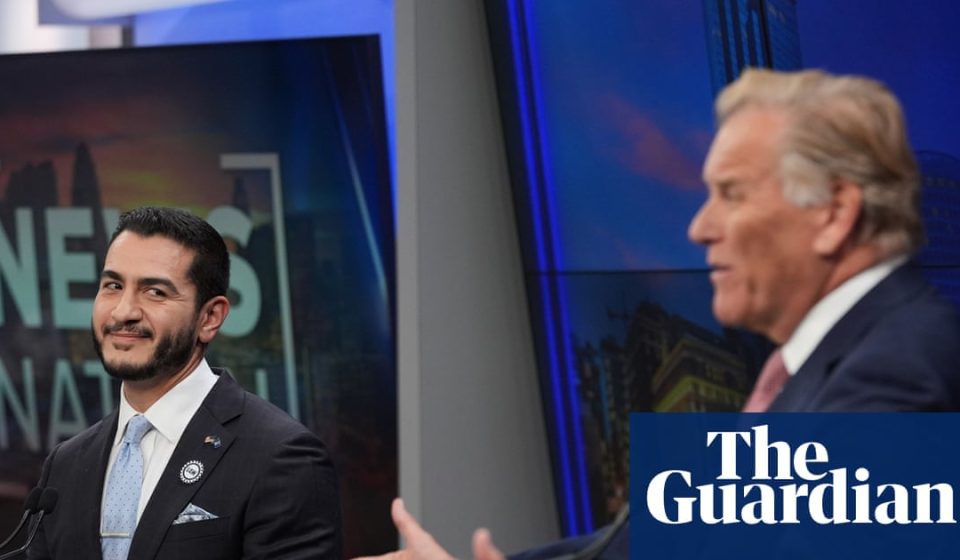
US midterms: Key takeaways from Senate debates in Michigan, Georgia and Maine | 2026 US midterm elections

1. Affordability, affordability, affordability
Affordability was a major topic in all three debates Thursday night, with voters consistently citing the cost of goods, gas, housing and health care as their top concerns in this year’s midterms.
“Can you afford your gas? Can you afford your groceries under this guy who’s going to approve of everything Donald Trump tells him to approve of?” El-Sayed asked during the Michigan debate, the first of two debates in one of the most hotly contested races this cycle.
Rogers and El-Sayed said they favored suspending a fuel tax to reduce costs, while El-Sayed argued that the war in Iran, which was driving up gasoline prices, must end. El-Sayed attacked Rogers for increasing his personal wealth while serving as a U.S. representative.
Rogers called El-Sayed “bought out” by billionaire George Soros, Hamas and Hezbollah. “We cannot afford to buy Abdul and we cannot risk his ideology,” Rogers said.
In Georgia, Ossoff repeatedly asked Collins to justify his support for Trump’s global tariff policies, which the senator said have “crushed Georgia families” and “strangled” economic growth.
“Let’s see if he has the courage to explain his votes,” Ossoff said, later adding, “I still haven’t heard an explanation on the tariffs.”
Collins, who is trying to narrow Ossoff’s lead, blamed inflation on the Biden administration’s policies, pointing to spending measures his opponent had supported.
Later in Maine, where polls show a tight race, Jackson focused his remarks on pocketbook issues, including sharply rising fuel costs and high energy prices.
Collins defended his record and argued that Maine benefited from the $50 billion rural health transformation fund that was attached to the tax and spending cut bill signed by Trump, the so-called Big Beautiful bill.
2. It gets personal in Georgia
During the Georgia debate, a question about data centers led to a pointed, personal exchange between Ossoff and Collins.
“Mike Collins voted to take this money out of your pocket and your community and give it to data center developers,” Ossoff said.
He then accused Collins of being a “fanatic” who “hired half the Third Reich” — a reference to the congressman’s history of employing staffers who expressed white nationalist, anti-Semitic and extremist views online.
“If John Lewis walked from Selma to Montgomery today,” Ossoff said of the late civil rights icon and longtime Georgia congressman, “Mike Collins would be grabbing a baton. His office is in cahoots with some of the most notorious white supremacists in the country.”
Collins was asked directly about his son-in-law’s social media posts promoting white nationalist and anti-Semitic views.
“You know, Rick, that’s my family,” Collins replied. “That’s the madness Jon Ossoff poured out there.” Collins noted that a New York man was recently indicted after threatening to kill him, and added: “I condemned racism, anti-Semitism, hatred; I don’t care where the source is. And I also tell him that’s wrong. We have no place in this world for that.”
Collins, meanwhile, sought to portray Ossoff as a “radical” and “extremist” whose record in the Senate had left the state “less safe, more expensive and worse off.”
3. Labatt and the Red Wings in Michigan
Tariffs have also been the subject of heated debate in Michigan, which shares hundreds of miles of border with Canada.
This week, Rogers publicly walked back his previous support for Trump’s tariffs on the United States’ northern neighbor, saying in a campaign ad that “Canada is not our enemy” and that the “tariff war” needed to end now.
During Thursday night’s debate, Rogers said he spoke to Commerce Secretary Howard Lutnick this week to advocate for a deal between the two countries. Some current rates are “too high and don’t help us,” Rogers said.
El-Sayed said he supports targeted, logical tariffs that protect Michigan’s manufacturing industry, but nothing like the “brutal, chaotic and self-serving” tariffs implemented by Trump. He criticized Rogers for his “about-face” on the issue, saying he was only reversing his position due to “slumping poll numbers.”
“He does a commercial drinking a Labatt and talking about the Red Wings, pretending he wasn’t for that the whole time,” El-Sayed said. “Be serious, dude.”
4. Accusations are flying in Maine
In Maine, discussions over gas prices and the war in Iran sparked notable tensions in the second debate between Jackson and Collins, who is seeking a sixth term in his seat.
“She’s the appropriations chair,” Jackson said. “The money has to go through them for these wars – she can still do something. »
Collins, who plans to continue leading the Appropriations Committee if re-elected, said she has repeatedly supported war powers’ resolutions to end Trump’s military action in Iran.
But Jackson went further, accusing the senator and her husband of profiting from the war.
She could use her influence to stop this war, but instead they are making money,” he said, prompting a furious response from Collins, who called the allegation “absolutely outrageous.”
“You owe me an apology,” she said.
5. Reproductive rights in the spotlight in Maine
In Maine, both candidates were also pressed to address inconsistencies in their positions on reproductive rights, a crucial issue for the state’s voters.
“Our records have changed,” Jackson said. “Mine got better, his got worse.”
He highlighted Collins’ vote to confirm Supreme Court Justice Brett Kavanaugh, who helped overturn Roe v. Wade in 2022. Collins, one of two Republican senators to support abortion rights, said she did not regret her vote for Kavanaugh, although she believed he gave her private assurances before her confirmation in 2018 that he would not overturn the historic decision.
Collins sought to turn the issue back on his opponent, pointing to his past positions on abortion that have left many voters wary.
“From 2000 until he ran for office in 2013, it was very anti-choice,” she said, accusing Jackson of holding “extremist” views on abortion. “He was for a bill that would ban abortion when the mother’s life was in danger.”
She also highlighted legislation she helped write that sought to “codify Roe v Wade on a national scale,” but the bill never passed the Senate.
6. Mittens removed in Michigan
In Michigan, Rogers repeatedly attacked El-Sayed by attempting to link him to Muslim terrorist groups, including Hamas, and suggested that government surveillance would only bother someone if he or his family had something to hide.
Rogers brought up El-Sayed’s mother and sister, prompting El-Sayed to say at one point that Rogers should just come out and say why he danced all night, after Rogers’ repeated references to terrorist groups.
“He wants it to be about anything but his own record,” El-Sayed said.
Rogers claimed that El-Sayed refused to condemn a terrorist attack in Michigan earlier this year and the Hamas terrorist attacks in Gaza on October 7, although El-Sayed said he had condemned both.
But El-Sayed added: “I am not someone who tries to make political theater out of the pain of others. »
He also retorted to Rogers: “Have you sold your yachts? Rogers responded, “I never owned a yacht in Florida, bro. »
After a 30-second commercial break, moderator Rick Albin said that in his 30 years of hosting talk shows, he had never seen the fights continue during the break, but tonight they did.
Gn headline