

Walmart aims to make it as easy as possible for its customers to find exactly what they want.
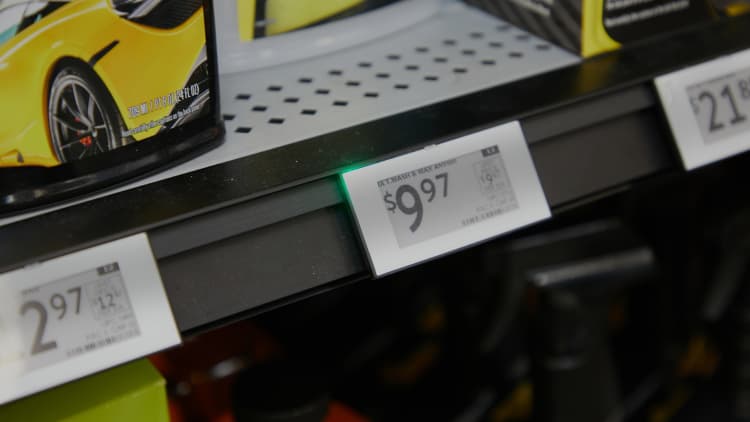
The retailer is leveraging three new tools linked to its digital shelf labels to help customers and store associates better find products. This is the latest part of the company’s efforts modernize its technology and integrate artificial intelligence into its activity.
“We are led by people and powered by technology,” said Greg Cathey, senior vice president of digital transformation at Walmart. “But for us, AI is a way to help associates do their jobs and free up their time so they can invest in what they love doing most, which is spending more time with customers and colleagues.”
The new shopper-facing feature, called Shop to Light, allows customers to find specific products on the Walmart app, navigate to the correct section of the store, then scan the product’s digital label to locate it. The retailer is now widely integrating it following a pilot program.
This tool is also associated with Pick to Light and Stock to Light, which use the same functionality to assist store associates in selecting items for digital orders and stocking products. All three features will roll out to the company’s stores by the holiday season, Cathey said.
“This is a use case that customers and associates have been asking us for,” Cathey said. “It gives them time back, and I think if you look at a lot of what we’re trying to do, it’s all about convenience and being able to help associates and customers free up that time to invest it where they want to invest it.”
The rollout comes as convenience and speed, particularly in the delivery and pickup segments, have become essential parts of Walmart’s efforts to increase sales. While Walmart’s business has seen steady growth and its online sales continue to soar, investor concerns about its comparable sales and revenue outlook weighed on its shares after its last earnings report in August.
Walmart stores carry approximately 120,000 items. Cathey said the company’s priority is providing this wide range of products while making it easier for customers to locate specific items.
While the company is not publicly sharing any financial aspects of the program, Cathey said the new features in the pilot stores allow associates and customers more time to shop and stock up. The Shop to Light feature has already received 5 million flashes from customers since it began rolling out to limited locations this summer.
He said these new features will be particularly important as the retailer heads into the busy holiday season, and that the company considers them “a big win” in terms of time savings.
Walmart began using digital shelf labels, as opposed to paper labels, to enable the simultaneous deployment of automatic and system-wide price changes. The company currently has more than 4,300 stores with digital labels and expects to have them installed chainwide by the end of the year, according to Walmart.
He added that tag prices are changed overnight, when customers are not in the store, and that the system is also monitored by humans to ensure it has “robust governance” and does not make errors. Currently, about 90 percent of the store’s shelves have digital labels, he said.
“We don’t look at this as technology for its own sake,” Cathey said. “So we always have a human in the know, and we’re very focused on human judgment and their ability to make decisions.”
A broader technological push
The exterior company logo of a Walmart store window is seen in Saratoga Springs, Utah, United States, September 8, 2026.
Charles-McClintock Wilson | Nuphoto | Getty Images
Walmart has invested in its technology to modernize the business, both on the consumer side and internal operations.
It deployed an AI agent to help customers with their purchases, automated its supply chain, invested in radio frequency identification tags, and laid the groundwork for agent commerce as it adopts AI. It has also spent billions upgrading its stores.
During Walmart’s latest earnings call, its CEO, John Furner, said the company was seeing significant returns on its technology strategies, including its investments in AI.
“We believe AI will improve almost every aspect of our business by making purchasing easier and making our associates’ jobs easier,” he said.
Still, digital labels on shelves and the company’s AI push have sparked backlash. They raised concerns about dynamic pricing and fears that digital labels could lead to price hikes or privacy issues when collecting customer purchasing data.
But in an open letter last week, Furner said the company continues to “price the product, not the person,” adding that the retailer does not plan to use customer information to set prices.
“Your income, your purchase history, your urgency or what we think you might pay will not change the price,” Furner wrote.
Cathey, who has been in the role for nearly a year, said his biggest priority upon taking over was to focus on increasing the speed of the technology Walmart uses while still maintaining human oversight.
Several state legislatures, including New Jersey, have passed measures to restrict digital labels on shelves due to pricing concerns. Walmart said it has this feature in all of its New Jersey stores.
Walmart in a statement called the policy “an overreaction, because digital shelf labels are not a price monitoring tool and are simply a modern way of displaying prices.”
Walmart has also invested in drone delivery — which has faced similar scrutiny due to privacy concerns — to deliver products to customers in as little as 30 minutes. This delivery option is available in select states, including Texas and Florida.
Ultimately, Cathey said the new digital shelf label features are all part of the company’s broader goal to ensure store associates have more time to meet customers’ individual needs.
And while investors debate whether physical retail or e-commerce is more important to the company’s business, Cathey said the new features show the two go hand in hand.
“It’s no longer one or the other. It’s both,” he said. “We don’t think of it as a store or an e-commerce site. In reality, they are one and the same.”
Gn bussni